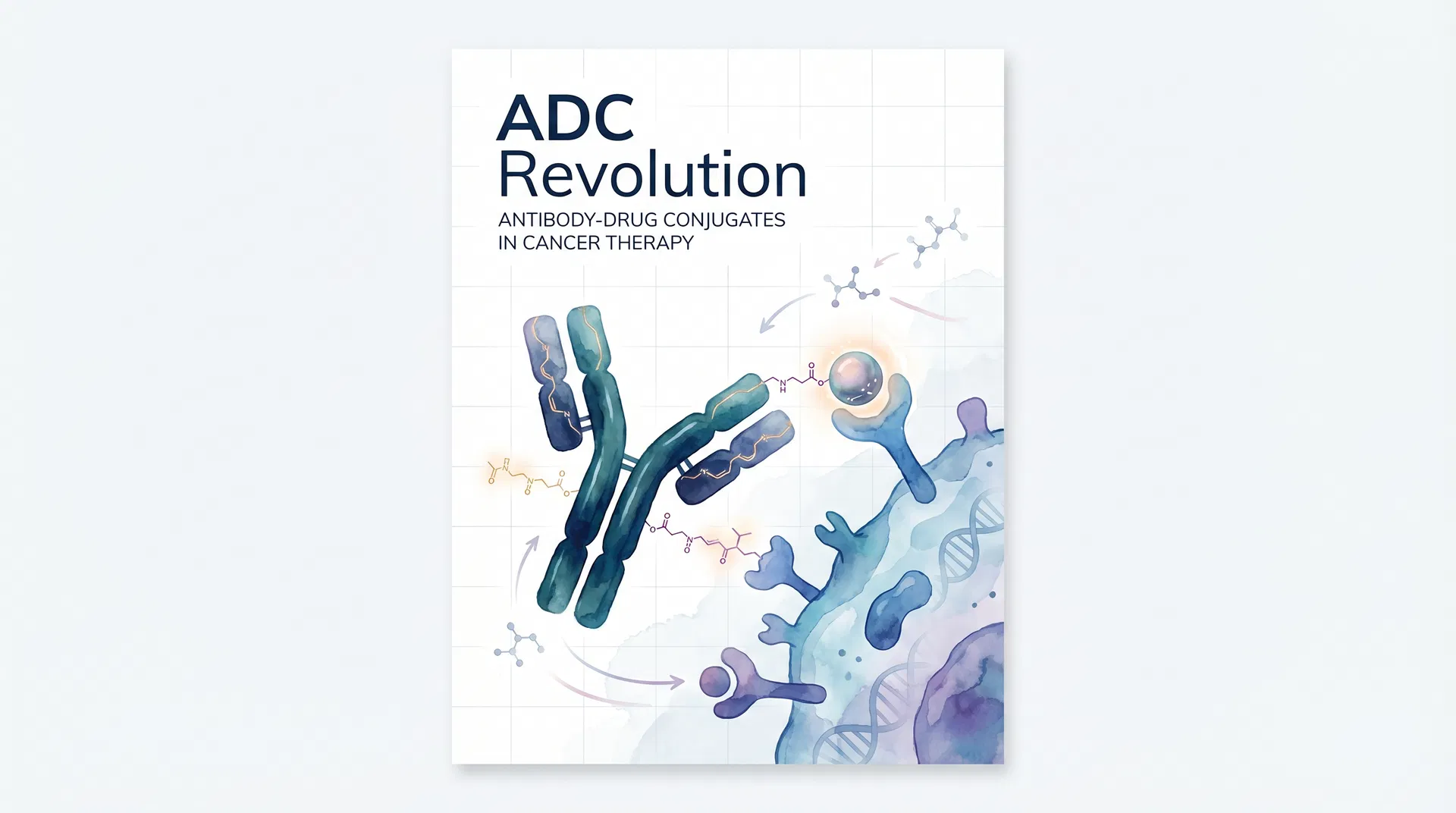
The ADC Revolution: How Antibody-Drug Conjugates Are Redefining Cancer Therapy at AACR 2026
Slug: adc-revolution-antibody-drug-conjugates-cancer-therapy-aacr-2026 Tags: antibody-drug conjugates, ADC, cancer therapy, AACR 2026, oncology, drug discovery, targeted therapy, biosecurity Excerpt: The 2026 AACR Annual Meeting confirmed that antibody-drug conjugates have become the defining therapeutic class of modern oncology. From mushroom-toxin payloads to next-generation bispecific designs, ADCs are reshaping how we treat cancer — and raising new questions for biosafety governance.
The American Association for Cancer Research (AACR) Annual Meeting 2026, held April 17–22 in San Diego, California, drew thousands of researchers, clinicians, and biotechnology leaders to share the latest advances in cancer science. Among the many themes that emerged from the conference, one stood out with unmistakable clarity: antibody-drug conjugates (ADCs) have moved from promising experimental agents to the dominant paradigm in precision oncology. For those working at the intersection of molecular biology, biosafety, and translational medicine, the data presented at AACR 2026 carries implications that extend well beyond the clinic.
What Are Antibody-Drug Conjugates?
An antibody-drug conjugate is a biopharmaceutical that combines the targeting precision of a monoclonal antibody with the cytotoxic power of a chemotherapy payload. The antibody component is engineered to recognise and bind to a protein antigen expressed on the surface of tumour cells, while a chemical linker tethers it to a highly potent drug molecule. Once the ADC binds to its target, it is internalised by the cancer cell, where the linker is cleaved and the payload is released directly inside the tumour cell, minimising systemic toxicity.
The elegance of this design has been understood for decades, but early ADCs were hampered by unstable linkers, off-target toxicity, and limited payload options. The generation of ADCs now entering clinical trials and regulatory review represents a fundamentally different class of molecule — one shaped by decades of iterative engineering in linker chemistry, payload biology, and antibody design.
AACR 2026: The Data That Defined the Moment
Several datasets presented at AACR 2026 illustrated the maturity and breadth of the ADC pipeline. Among the most discussed was QLS5132, a CLDN6-targeting ADC developed for ovarian cancer. CLDN6 (Claudin-6) is a tight junction protein highly expressed on the surface of ovarian cancer cells but largely absent from normal adult tissue, making it an attractive therapeutic target. Across all dose levels evaluated in the phase 1/2 study, 18 patients demonstrated an objective response rate (ORR) of 50% and a disease control rate of 94.4%. Critically, the phase 2 dosage did not produce cases of interstitial lung disease, ocular toxicity, oral mucositis, or febrile neutropenia — adverse events that have historically limited the clinical utility of ADC payloads.
Equally compelling was the data from Heidelberg Pharma on pamlectabart tismanitin, an amanitin-based ADC for multiple myeloma. Amanitin is a bicyclic peptide toxin derived from Amanita phalloides (the green death cap mushroom) that inhibits RNA polymerase II, a mechanism entirely distinct from the tubulin-disrupting or DNA-damaging payloads used in most existing ADCs. Because amanitin acts independently of cell proliferation, it retains activity against quiescent tumour cells — a population that frequently survives conventional chemotherapy and drives relapse. Heidelberg Pharma's chief executive officer described dose-dependent increases in ORRs from the phase 1 dose escalation trial as "very encouraging," and the company is advancing the compound as a potential replacement for conventional chemotherapy in certain haematological malignancies.
The ADC theme extended to lung cancer, where data in non-small cell lung cancer (NSCLC) and small cell lung cancer (SCLC) demonstrated sustained responses in patient populations that had exhausted standard-of-care options. Early-phase studies in smoldering multiple myeloma using CAR-T cell therapy were also presented, reflecting the broader shift toward molecularly targeted immunological approaches.
The Engineering Behind the Momentum
Dongzhou Jeffery Liu, CEO of Heidelberg Pharma, articulated the structural reasons for the ADC renaissance with precision: "Advances in linker technologies, payload design, and target selection are the reason for their growing popularity in the cancer care space. ADCs can now deliver highly potent drugs more selectively to tumour cells while limiting systemic side effects including off-target toxicity."
Three engineering dimensions are driving this progress. First, linker stability has improved dramatically. Early ADCs used acid-labile or disulfide-based linkers that released payload prematurely in the bloodstream; modern protease-cleavable and pH-responsive linkers release payload only inside the lysosomal compartment of target cells. Second, payload innovation has expanded the pharmacological toolkit. Beyond the auristatins and maytansinoids that dominated first-generation ADCs, researchers are now deploying topoisomerase I inhibitors, RNA polymerase II inhibitors (amanitin), and novel DNA-alkylating agents. Third, target selection has become more sophisticated, with proteomics and single-cell transcriptomics enabling the identification of antigens with high tumour specificity and low normal-tissue expression.
Beyond single-payload ADCs, the conference highlighted the emergence of dual-payload antibody-drug conjugates and bispecific ADCs — molecules that simultaneously target two tumour antigens or deliver two mechanistically distinct payloads. These next-generation designs aim to overcome the resistance mechanisms that limit the durability of first-generation ADCs.
Implications for Biosafety and Dual-Use Governance
The ADC field raises important questions that extend into biosafety and biosecurity governance. The use of highly potent biological toxins — including amanitin, ricin-related compounds, and synthetic analogues of natural toxins — as ADC payloads creates a dual-use dimension that regulatory frameworks are only beginning to address. The same linker-payload chemistry that enables selective tumour killing could, in principle, be repurposed to deliver toxic agents to non-cancer targets if the antibody component were redirected.
The Biological Weapons Convention (BWC) and national biosafety regulations were not designed with precision oncology payloads in mind. As ADC payloads become more potent and their synthesis more accessible, the scientific community and regulatory bodies must develop governance frameworks that distinguish legitimate therapeutic development from potential misuse. This is not a hypothetical concern: the synthesis of amanitin analogues, for example, requires specialised chemistry expertise but is increasingly documented in the open literature.
The African biosafety regulatory landscape is particularly underprepared for this challenge. Most African Union member states lack specific regulations governing the manufacture, import, and clinical use of ADCs, let alone the dual-use governance frameworks needed to oversee highly potent payload synthesis. Strengthening regional capacity in this domain — through harmonised regulations under the African Medicines Agency (AMA) and engagement with the BWC Implementation Support Unit — is an urgent priority.
A Policy Reform Agenda for ADC Governance
The rapid advancement of ADC technology demands a coordinated policy response across six dimensions:
| Reform Area | Current Gap | Recommended Action |
|---|---|---|
| Dual-use payload oversight | No specific BWC guidance on ADC payloads | Develop BWC technical guidelines for potent biological toxin payloads |
| African regulatory harmonisation | Fragmented national frameworks | AMA to develop ADC-specific guidelines aligned with ICH S9/Q3C |
| Biosafety classification | ADC synthesis facilities lack standardised BSL classification | WHO to issue guidance on ADC manufacturing biosafety levels |
| Export controls | Potent payloads not uniformly covered by Australia Group controls | Expand Australia Group common control list to include synthetic toxin analogues |
| Clinical trial oversight | Limited ADC trial capacity in LMICs | WHO/AFRO to support ADC clinical trial infrastructure in Africa |
| Public communication | Limited public understanding of ADC safety profiles | Science communication frameworks for ADC benefit-risk communication |
Conclusion
The data from AACR 2026 confirms that antibody-drug conjugates represent the most consequential advance in cancer pharmacology of the past decade. The convergence of improved linker chemistry, novel payload biology, and sophisticated target selection has produced a therapeutic class capable of delivering durable responses in cancers that were previously refractory to treatment. For molecular microbiologists, biosafety professionals, and biotechnology specialists, the ADC revolution is not merely a clinical story — it is a signal that the boundary between therapeutic biology and dual-use risk is becoming increasingly complex, and that governance frameworks must evolve at the same pace as the science.
Dr. Odongo Oduor Joseph is a biosecurity and biosafety expert, molecular microbiologist, and AI-driven scientific frameworks architect based in Nairobi, Kenya.