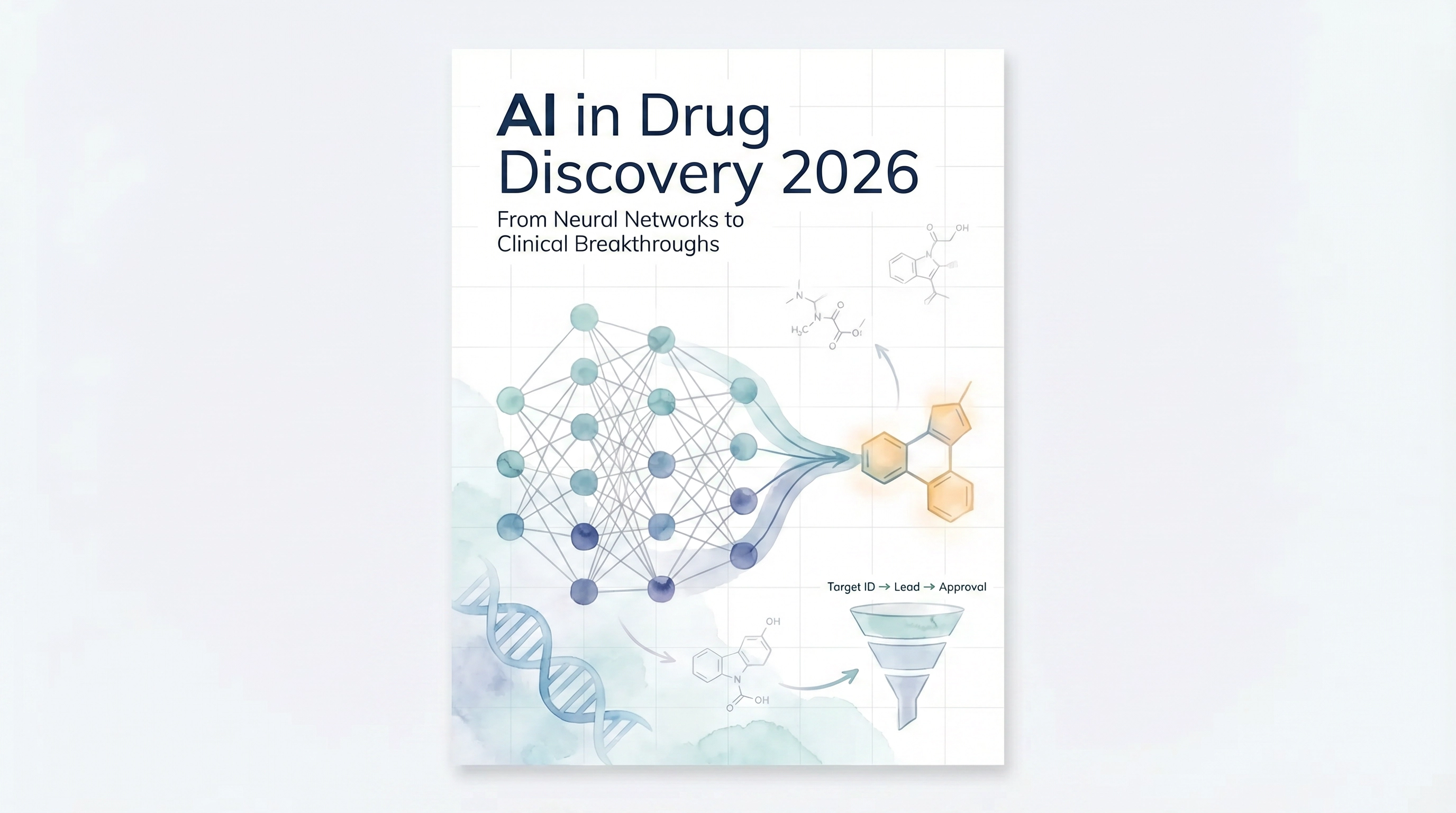
For decades, drug discovery has operated on a sobering statistical reality: roughly one in five candidate drugs causes negative health effects that outweigh its benefits, and of those that clear safety hurdles, approximately half ultimately fail to demonstrate sufficient efficacy in patients. The entire pipeline — from target identification to regulatory approval — routinely spans fifteen years and costs upwards of two billion dollars. In 2026, artificial intelligence is not merely accelerating this process; it is fundamentally restructuring how scientists think about disease, molecules, and therapeutic possibility.
The shift is quantifiable. The global AI-in-life-sciences market is projected to grow at a compound annual rate of 19.3 percent through 2035, while the AI-in-clinical-trials segment alone surged from $9.16 billion in 2025 to an estimated $13.08 billion in 2026 — a 42.8 percent annual increase. Major pharmaceutical companies, from Pfizer to Novo Nordisk, are doubling down on AI-powered modelling tools and automated laboratory systems, betting that the technology can shave years off development timelines and hundreds of millions off R&D budgets.
What AI Actually Does in the Discovery Pipeline
The power of modern AI in drug discovery rests on its capacity to identify higher-order correlations across petabytes of biological data — a volume equivalent, as researchers at Georgia Institute of Technology have noted, to roughly half the contents of all United States academic research libraries. Where a human scientist might spend months cross-referencing a few hundred studies, a deep learning model can integrate genomic sequences, protein interaction maps, clinical trial records, and published literature simultaneously, surfacing connections that would otherwise remain invisible.
At the molecular level, tools descended from DeepMind's AlphaFold — which predicts the three-dimensional, bioactive structure of proteins from amino acid sequences — have transformed target identification. Once a disease-driving protein is structurally characterised, generative AI models can propose small molecules or biologics designed to bind to it with precision. The 2026 patent landscape in AI drug discovery already encompasses more than sixty distinct records covering generative molecular design, drug-target interaction prediction, and drug repurposing strategies, reflecting the pace at which the field is maturing.
Perhaps the most consequential development is AI's capacity to map disease interrelationships. Many chronic conditions — cancers, autoimmune disorders, neurodegenerative diseases — are not caused by a single malfunctioning protein but by networks of dysregulated biology. AI can now model these networks and identify common upstream drivers, opening the possibility of broad-spectrum treatments that address whole collections of related diseases rather than narrow, single-target interventions. Epidemiological patterns, such as the well-documented co-occurrence of hyperthyroidism and Alzheimer's disease, are being reanalysed through this lens, with AI helping researchers trace shared molecular pathways that might yield dual-purpose therapies.
The Precision Medicine Convergence
AI's impact extends beyond the laboratory bench into the clinic. On 23 April 2026, Tempus and the University of Southern California announced a strategic collaboration to accelerate AI-driven precision medicine, integrating Tempus's advanced molecular diagnostics and comprehensive genomic profiling with USC's clinical research infrastructure. The partnership exemplifies a broader industry trend: the convergence of AI, multi-omics data, and real-world clinical evidence into personalised treatment frameworks that match the right therapy to the right patient at the right time.
A parallel Nature publication from April 2026 offered a measured assessment of this convergence, noting that while the Precision Medicine Initiative — launched a decade ago — has delivered clear benefits in oncology and select genetic conditions, its broader population-level impact remains uneven. The authors argue that statistical rigour and data-driven frameworks must be strengthened to translate AI-generated insights into equitable clinical outcomes, particularly for populations historically underrepresented in genomic databases.
Honest Caveats
The enthusiasm surrounding AI in drug discovery is warranted, but so is a degree of scientific caution. As Professor Jeffrey Skolnick of Georgia Tech has emphasised, AI is not yet a substitute for real experiments and clinical validation. Models can hallucinate — generating plausible-sounding but ultimately false biological connections — and the quality of AI output is fundamentally constrained by the quality of the experimental data on which it is trained. A 2026 Nature commentary on federated learning in drug discovery argues that improving access to pooled, high-quality training data across institutions is the critical bottleneck that must be addressed before the technology's full promise can be realised.
The trajectory, nonetheless, is clear. By the end of this decade, AI will not merely assist drug discovery — it will define its architecture.
Sources: Georgia Institute of Technology (April 2026); BioSpace AI in Life Sciences Market Report (April 2026); Nature — Precision Medicine Initiative (April 2026); Reuters — Pharma doubles down on AI (April 2026); Tempus/USC Collaboration Announcement (April 2026).