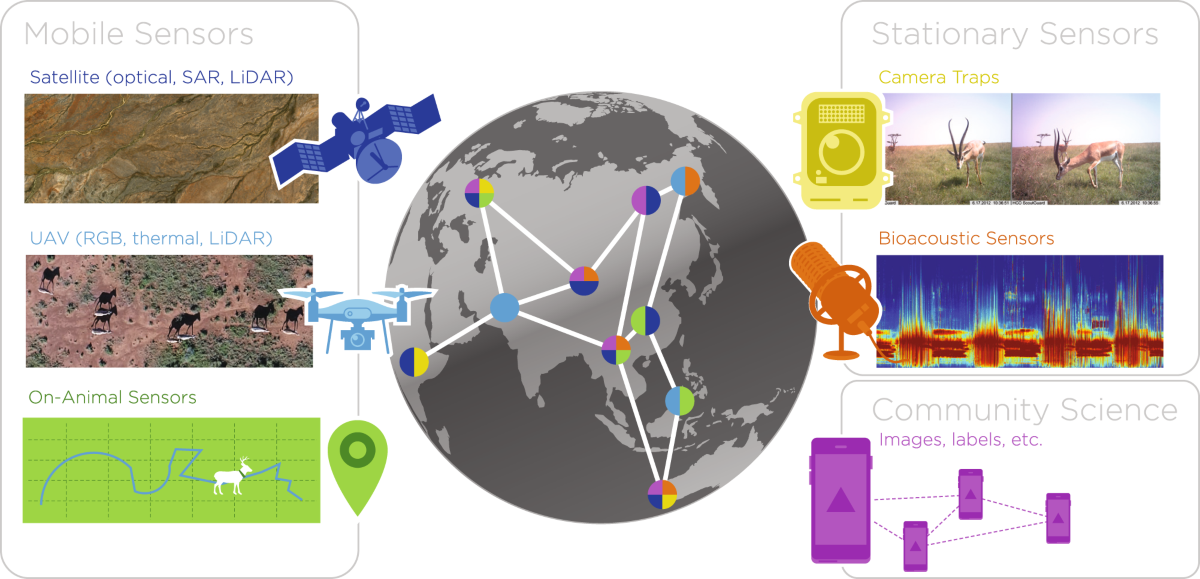
The sixth mass extinction is not a future event. It is happening now, at a rate estimated to be 100 to 1,000 times higher than the natural background extinction rate, driven by habitat destruction, climate change, invasive species, overexploitation, and pollution. The Intergovernmental Science-Policy Platform on Biodiversity and Ecosystem Services (IPBES) estimates that approximately one million species are currently threatened with extinction — a figure that represents not just an ecological tragedy but a fundamental threat to the ecosystem services on which human civilisation depends.
Addressing this crisis requires, first and foremost, understanding it. Effective conservation depends on knowing what species exist where, in what numbers, under what conditions, and how those parameters are changing over time. This is a data problem of enormous scale and complexity — and it is precisely the kind of problem that AI and environmental biotechnology are uniquely positioned to address. The convergence of these disciplines is creating a new generation of conservation tools that are faster, cheaper, more comprehensive, and more predictive than anything previously available.
Environmental DNA: Reading the Invisible Signatures of Life
Environmental DNA (eDNA) metabarcoding has emerged as one of the most powerful tools in the conservation biologist's toolkit. Every organism sheds DNA into its environment — through shed skin cells, mucus, faeces, and decomposing tissue. By collecting water, soil, or air samples and sequencing the DNA they contain, researchers can detect the presence of species without ever observing them directly — a capability that is particularly valuable for rare, cryptic, or aquatic species that are difficult to survey by conventional methods.
The analytical challenge of eDNA metabarcoding is substantial. A single water sample from a river or lake may contain DNA fragments from hundreds or thousands of species, mixed with environmental noise, degraded sequences, and contamination. Machine learning is transforming the analysis of these complex datasets. Deep learning classifiers trained on curated reference databases can assign taxonomic identities to eDNA sequences with high accuracy, even for species that are poorly represented in existing databases. Convolutional neural networks applied to eDNA sequence data can identify not just species presence but relative abundance, enabling the construction of comprehensive biodiversity indices from a single water sample.
In sub-Saharan Africa, eDNA metabarcoding combined with machine learning has been used to survey freshwater fish communities in rivers and lakes that are inaccessible to conventional sampling methods — providing the first comprehensive biodiversity assessments of ecosystems that have been monitored only sporadically for decades. In marine environments, eDNA surveys are being used to track the recovery of fish populations following the establishment of marine protected areas, providing near-real-time feedback on the effectiveness of conservation interventions.
Acoustic Monitoring and Bioacoustic AI
The soundscape of a healthy ecosystem is extraordinarily rich. Birds, insects, frogs, marine mammals, and even trees (through the sounds of water movement in their vascular tissue) produce acoustic signals that encode information about species identity, behaviour, population density, and ecosystem health. Passive acoustic monitoring — deploying recording devices in natural environments and analysing the resulting audio data — has long been recognised as a powerful biodiversity assessment tool, but the sheer volume of data generated has historically made comprehensive analysis impractical.
Machine learning has transformed this situation. Deep learning models trained on labelled audio datasets can identify species from their vocalisations with accuracy that matches or exceeds expert human listeners, and can process thousands of hours of audio data in the time it would take a human analyst to review a single hour. The BirdNET neural network, developed by the Cornell Lab of Ornithology, can identify over 6,000 bird species from audio recordings. Similar models have been developed for bats, frogs, cetaceans, and insects.
Beyond species identification, AI is being used to derive higher-level ecological indices from acoustic data. The Acoustic Complexity Index, the Bioacoustic Index, and the Soundscape Diversity Index — all derived from the statistical properties of audio recordings — correlate with biodiversity and ecosystem health in ways that can be tracked continuously and automatically. Anomaly detection algorithms can identify sudden changes in soundscape composition that may indicate disturbance events — illegal logging, poaching, or the arrival of invasive species — enabling rapid conservation responses.
Remote Sensing and Habitat Mapping at Scale
Satellite and aerial remote sensing has long been used for habitat mapping and land cover classification, but the integration of machine learning has dramatically expanded the scope and resolution of what is possible. Deep learning models applied to multispectral and hyperspectral satellite imagery can map vegetation types, detect forest degradation, monitor wetland extent, and track the spread of invasive plant species with a spatial resolution and temporal frequency that was previously unachievable.
Convolutional neural networks trained on high-resolution satellite imagery can count individual trees in savanna ecosystems, map coral reef health from underwater photogrammetry, and detect the presence of specific plant species from their spectral signatures. These capabilities are being deployed at continental scales: the Global Forest Watch platform uses machine learning to provide near-real-time alerts of forest disturbance across the tropics, enabling conservation organisations and government agencies to respond to illegal deforestation within days rather than months.
| Technology | Data Type | ML Approach | Conservation Application |
|---|---|---|---|
| eDNA metabarcoding | DNA sequences | Deep learning classifiers, taxonomic assignment | Species detection, biodiversity assessment |
| Passive acoustic monitoring | Audio recordings | CNN, transformer models | Species identification, soundscape analysis |
| Satellite remote sensing | Multispectral imagery | CNN, semantic segmentation | Habitat mapping, deforestation detection |
| Camera traps | Images/video | Object detection, species ID | Wildlife population monitoring |
| Citizen science platforms | Geotagged observations | Ensemble models, data fusion | Species distribution mapping |
| Genomic surveillance | Population genomes | Population genetics + ML | Genetic diversity monitoring, inbreeding detection |
Predictive Species Distribution Models and Climate Adaptation
Understanding where species are today is necessary but not sufficient for effective conservation. Effective conservation also requires predicting where species will be in the future — under different climate scenarios, land use trajectories, and management interventions. Species distribution models (SDMs) — statistical models that relate species occurrence records to environmental variables — have been used for this purpose for decades, but classical SDM approaches are limited by their inability to capture complex, non-linear relationships between species and their environments.
Machine learning SDMs, including random forests, gradient boosting machines, and deep neural networks, consistently outperform classical approaches on predictive accuracy benchmarks, particularly for species with complex environmental relationships or sparse occurrence data. These models are being used to identify climate refugia — areas where suitable habitat conditions are projected to persist under future climate scenarios — that should be prioritised for protection. They are also being used to design wildlife corridors that connect fragmented habitat patches, enabling species to track suitable conditions as the climate shifts.
In East Africa, machine learning SDMs are being used to predict the future distribution of key savanna species — including elephants, lions, and wild dogs — under different climate and land use scenarios, informing the design of transboundary conservation areas that can accommodate the range shifts projected for the coming decades. Similar approaches are being applied to marine ecosystems, predicting the redistribution of fish stocks and the contraction of coral reef habitat under ocean warming and acidification scenarios.
AI-Guided Ecological Restoration
The most ambitious application of AI in conservation is the guidance of ecological restoration — the active reconstruction of degraded ecosystems. Restoration ecology has historically been guided by qualitative principles and expert judgment, with limited ability to predict the outcomes of specific interventions or to optimise restoration strategies for specific conservation objectives.
Machine learning is changing this. Models trained on data from restoration projects around the world can predict the probability of restoration success under different conditions, identify the species combinations most likely to establish self-sustaining plant communities, and optimise the spatial configuration of restoration interventions to maximise connectivity and biodiversity outcomes. Reinforcement learning algorithms are being used to design adaptive management strategies — sequences of interventions that respond to observed ecosystem responses — that outperform static management plans in dynamic, uncertain environments.
In the context of African savanna restoration, AI models are being used to optimise the reintroduction of locally extinct species, predicting the cascading effects of predator reintroduction on prey populations, vegetation structure, and carbon sequestration. These models are not crystal balls — ecological systems are inherently complex and unpredictable — but they provide a principled framework for navigating that complexity, enabling conservation practitioners to make better-informed decisions with the data they have.
The integration of AI and environmental biotechnology into conservation science is not a replacement for the fieldwork, community engagement, and political will that effective conservation requires. But it is a powerful amplifier of those efforts — enabling conservationists to see more, understand more, and act more effectively in the face of a biodiversity crisis that demands nothing less than our best science.