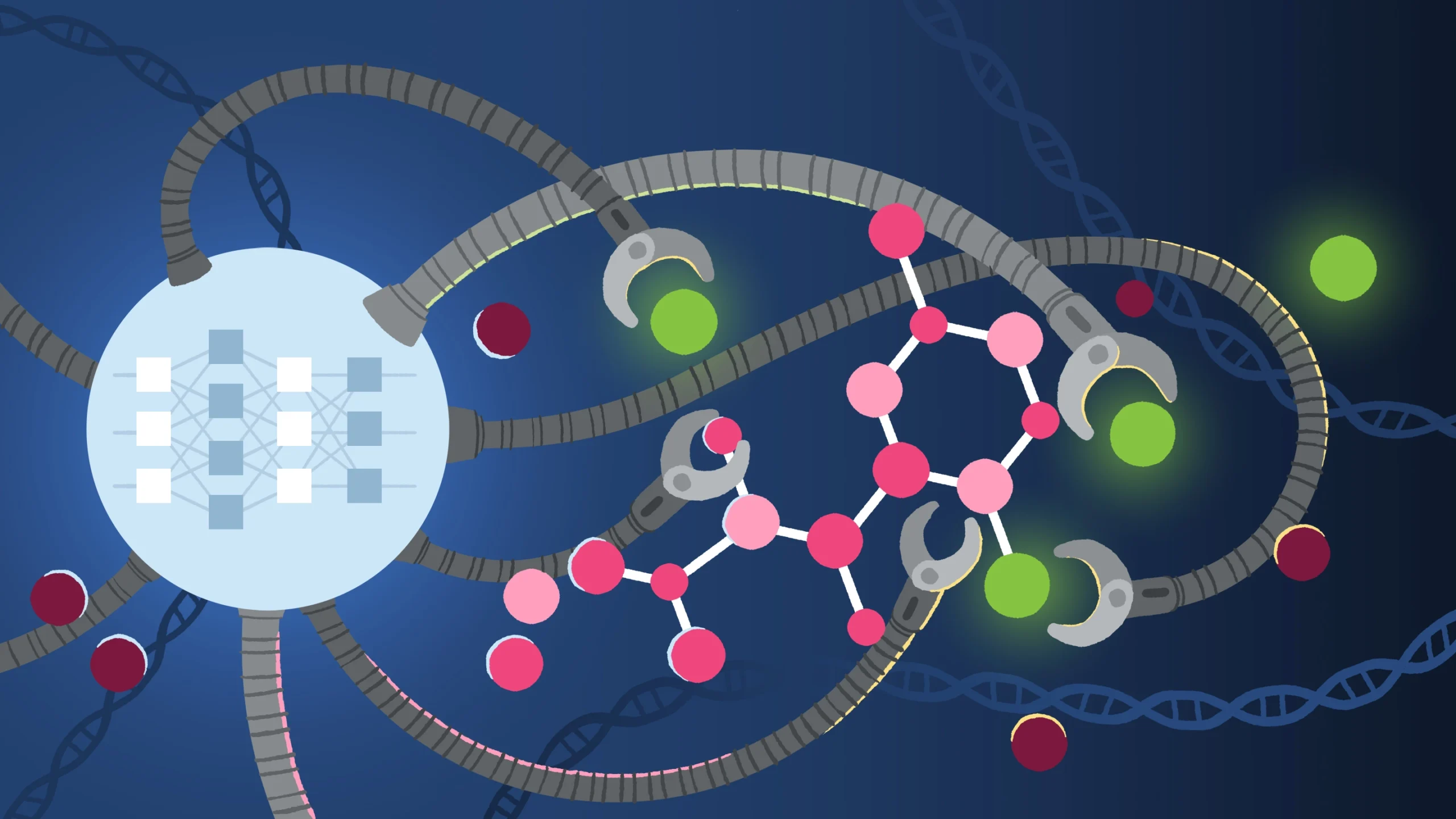
Gene Expression to Gravity: Using AI-Enhanced Simulations to Bridge the Gap Between Classroom Biology and Research-Level Understanding
One of the most persistent challenges in biological education is the gap between declarative knowledge and operational understanding. A student can memorise the steps of transcription — promoter binding, RNA polymerase progression, mRNA synthesis — without ever developing the intuitive grasp of how those steps interact, how they can be disrupted, or why they matter for understanding disease, drug targets, and genetic engineering. The same gap exists in every domain of biology: between knowing that natural selection operates on heritable variation and truly feeling the dynamics of allele frequency change under selection pressure; between understanding that neurons fire action potentials and grasping the electrochemical logic that makes that firing threshold-dependent and self-propagating.
Bridging this gap has historically required either years of laboratory experience or exceptional teaching. AI-enhanced simulation platforms like WebletGPT are creating a third path: immersive, interactive environments where the dynamics of biological systems can be explored directly, at any pace, with an AI tutor available to explain every observation in real time.
The Biology Simulation Suite: What Is Available and Why It Matters
WebletGPT's biology collection currently includes 12 simulations covering three of the most conceptually rich areas of introductory and intermediate biology. The Gene Expression Essentials simulation allows learners to observe transcription and translation in real time — watching RNA polymerase bind to a promoter, read the template strand, and produce an mRNA molecule that is subsequently decoded by ribosomes to produce a protein. This is the central dogma of molecular biology made visible and manipulable, not as a diagram in a textbook but as a dynamic process that responds to the learner's interventions.
The Natural Selection simulation places the learner in the role of evolutionary observer, watching a population of bunnies adapt to environmental pressures as wolves are introduced, fur colour mutations arise, and differential survival reshapes the allele frequencies of the population over generations. The Neuron simulation allows exploration of action potential generation — the threshold stimulus, the rapid depolarisation driven by sodium influx, the repolarisation driven by potassium efflux, and the refractory period that prevents backward propagation — all rendered as an interactive electrochemical process rather than a static diagram.
| Simulation | Core Concept | Research Relevance |
|---|---|---|
| Gene Expression Essentials | Transcription, translation, central dogma | Genetic engineering, CRISPR, drug target identification |
| Natural Selection | Allele frequency, adaptation, evolutionary dynamics | Antimicrobial resistance, conservation genetics, population genomics |
| Neuron | Action potential, membrane potential, ion channels | Neuropharmacology, neurological disease, electrophysiology |
AI Tutoring at the Moment of Maximum Cognitive Readiness
The integration of AI-powered chat into the simulation environment addresses a fundamental problem in science learning: the mismatch between the timing of confusion and the availability of explanation. When a learner observes that the bunny population fails to adapt when the mutation rate is set to zero, the question that arises — why does genetic variation matter for evolution? — is maximally productive at that exact moment. An AI tutor embedded in the simulation can answer that question immediately, in the context of what the learner just observed, connecting the simulation result to the broader principle of Darwinian evolution and its implications for understanding antibiotic resistance, cancer evolution, and conservation biology.
This is qualitatively different from consulting a textbook or watching a lecture video. The explanation is contextualised, immediate, and responsive to the specific observation that generated the question. It converts a moment of confusion into a moment of understanding, and it does so at the learner's pace rather than the curriculum's pace.
Connecting Simulation Intuition to Research Practice
For students and early-career researchers transitioning from coursework to research, the intuitions developed through simulation-based learning have direct practical value. A researcher who has spent hours manipulating the Gene Expression Essentials simulation — experimenting with different promoter strengths, observing the effect of ribosome binding site mutations, watching protein production rates respond to transcription factor concentrations — arrives at a molecular biology laboratory with a richer mental model of gene regulation than one who has only read about it.
Similarly, a conservation biologist who has explored the Natural Selection simulation across dozens of parameter combinations — varying population size, mutation rate, selection pressure, and environmental change — has developed an intuitive grasp of evolutionary dynamics that makes population genetics models more immediately interpretable. The simulation does not replace the mathematics of Hardy-Weinberg equilibrium or the statistics of FST analysis, but it provides the conceptual scaffolding that makes those tools meaningful rather than mechanical.
Implications for Biosafety and Biotechnology Education
From a biosafety and biotechnology education perspective, AI-enhanced biology simulations offer particular value in building the foundational understanding that underpins risk assessment and regulatory decision-making. A biosafety officer evaluating a proposal for genetically modified organism release needs to understand gene expression regulation, horizontal gene transfer dynamics, and evolutionary adaptation — not at a superficial level, but with the kind of operational intuition that allows them to identify non-obvious risks and ask the right questions.
Platforms like WebletGPT provide an accessible, scalable pathway to that operational understanding. They are not a substitute for formal training in molecular biology or biosafety regulation, but they are a powerful complement — a way of building and maintaining the intuitive grasp of biological dynamics that makes formal knowledge applicable in practice.
Conclusion
The biology simulations available on WebletGPT represent a significant resource for anyone seeking to develop or maintain operational understanding of core biological concepts — from students encountering gene expression for the first time to researchers refreshing their intuition about evolutionary dynamics to biosafety professionals building the conceptual foundation for evidence-based risk assessment. The combination of interactive simulation and AI tutoring creates a learning environment that is more responsive, more contextualised, and more effective than any previous generation of educational technology.
Access the full biology simulation library at webletgpt.com.