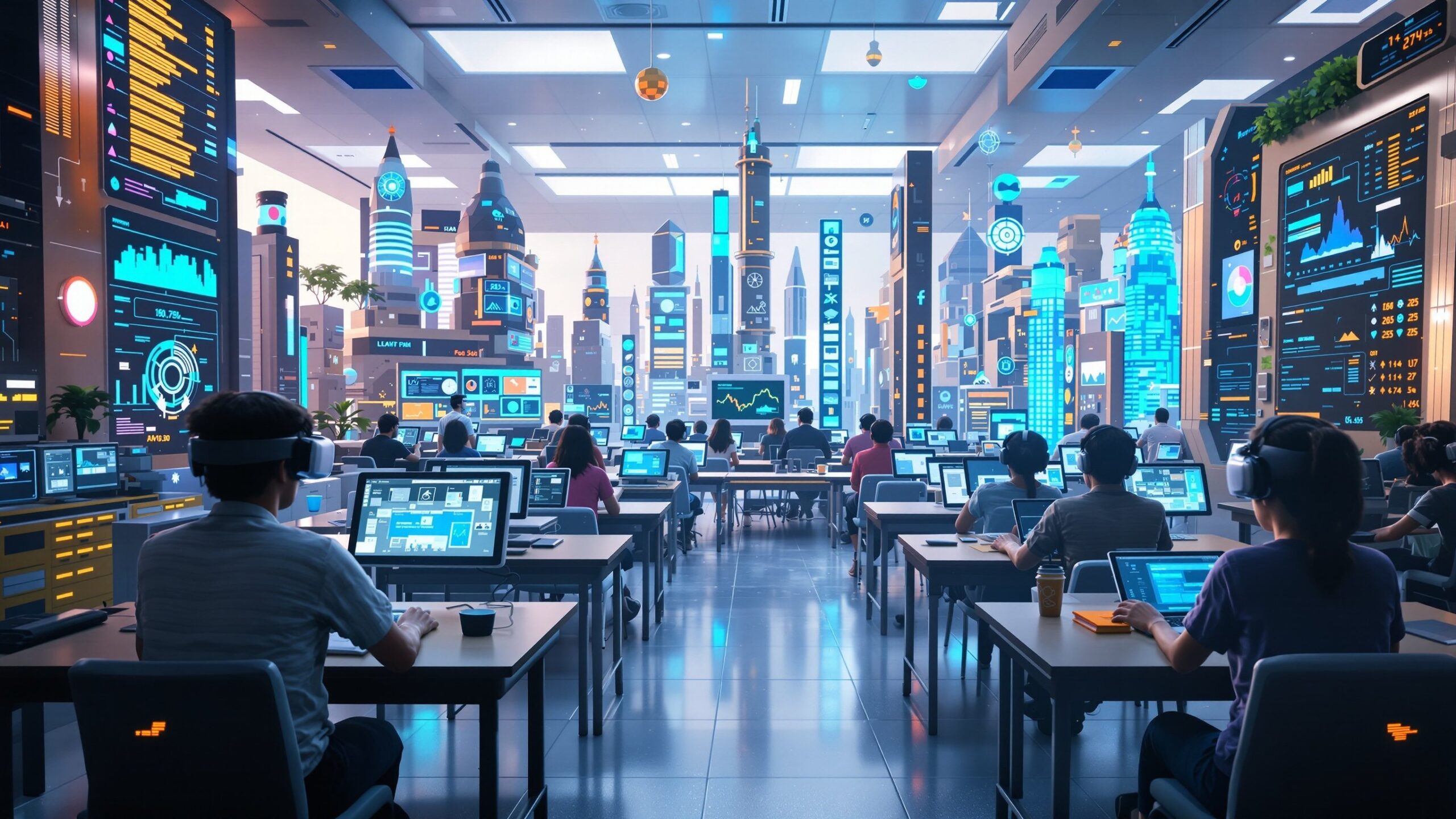
AI Tutors, Interactive Experiments, and the Future of Science Literacy: What WebletGPT Tells Us About the Next Generation of Scientific Education
The world's most pressing challenges — pandemic preparedness, climate change, antimicrobial resistance, food security, biosecurity governance — share a common prerequisite: a scientifically literate population capable of understanding evidence, evaluating risk, and participating meaningfully in decisions that turn on technical complexity. Yet science literacy, as conventionally measured, remains stubbornly low across most of the world. The gap between the scientific knowledge required to navigate the twenty-first century and the scientific knowledge most people actually possess is not merely an educational problem. It is a governance problem, a public health problem, and an existential risk management problem.
The question of how to close that gap at scale has no simple answer, but the emergence of AI-enhanced interactive simulation platforms like WebletGPT offers a genuinely new set of tools for addressing it — tools that are accessible, adaptive, and capable of building the kind of deep conceptual understanding that survives the examination hall and informs real-world decision-making.
What Makes AI-Enhanced Simulation Different from Previous EdTech
Educational technology has a long history of promising more than it delivers. Interactive whiteboards, MOOCs, gamified learning apps — each generation of EdTech has been greeted with enthusiasm and subsequently found to produce modest, inconsistent improvements in learning outcomes. The reasons are well understood: most EdTech digitises existing pedagogical approaches without fundamentally changing the learning experience. A video lecture is still a lecture. A digital textbook is still a textbook. The medium changes; the cognitive engagement does not.
AI-enhanced simulation represents a genuine departure from this pattern for two reasons. First, interactive simulation changes the cognitive mode of the learner from passive reception to active experimentation. When a student runs a projectile motion simulation and discovers that the range of a projectile is maximised at 45 degrees — not because a textbook told them so, but because they tested it across a range of angles and observed the result — they are engaging in the cognitive process of scientific inquiry, not the cognitive process of information absorption. Second, the integration of AI tutoring into the simulation environment means that the moment of discovery is immediately followed by the moment of explanation, closing the feedback loop that is essential for learning.
WebletGPT's platform combines both elements: 97 browser-based simulations across physics, chemistry, and biology, each enhanced with AI-powered chat, guided walkthroughs, contextual hints, and curriculum-aligned learning objectives. The result is a learning environment that is simultaneously exploratory and structured, self-directed and guided, accessible to elementary school students and informative for advanced researchers.
The Accessibility Imperative
One of the most significant features of browser-based simulation platforms is their accessibility. No laboratory equipment is required. No institutional affiliation is necessary. No geographic constraint applies. A student in rural Kenya with a smartphone and an internet connection can run the same gene expression simulation as a student at a research university in London. A biosafety officer in a low-resource regulatory agency can explore the same natural selection dynamics as a population geneticist at a well-funded research institute.
This matters enormously for global science literacy. The traditional laboratory-based model of science education is expensive, geographically concentrated, and institutionally gated. It produces excellent scientists in well-resourced environments and systematically underserves everyone else. Browser-based simulation platforms with AI tutoring have the potential to decouple science education from institutional infrastructure, making the experiential core of scientific learning available to anyone with internet access.
Adaptive Learning and the AI Tutor
The AI-powered chat feature on WebletGPT represents more than a convenient question-answering tool. It is the beginning of a genuinely adaptive learning experience — one that responds to the specific questions, confusions, and discoveries of each individual learner rather than delivering the same explanation to every student regardless of their prior knowledge, learning style, or current state of understanding.
When a learner asks the AI tutor why the pH of a solution changes when an acid is added, the quality of the response depends on what the learner already knows. A response calibrated for an elementary school student explaining the concept of hydrogen ions is different from a response calibrated for a chemistry undergraduate connecting pH to the Henderson-Hasselbalch equation, which is different again from a response calibrated for a biochemist thinking about enzyme activity and protein folding. An AI tutor with access to the learner's interaction history and the context of the current simulation can, in principle, calibrate its explanations to the learner's level and trajectory — providing the right explanation at the right moment for the right person.
Science Literacy as Infrastructure for Global Challenges
The ultimate argument for platforms like WebletGPT is not pedagogical but civilisational. The decisions that will determine whether humanity successfully navigates the biosecurity risks of advanced biotechnology, the public health challenges of emerging infectious diseases, the ecological consequences of climate change, and the governance challenges of artificial intelligence are not decisions that can be made by scientists alone. They require informed publics, literate policymakers, and engaged citizens who can evaluate evidence, understand uncertainty, and participate meaningfully in technically complex governance processes.
Building that level of science literacy at global scale requires educational infrastructure that is accessible, effective, and scalable — infrastructure that can reach a student in Nairobi as effectively as a student in New York, that can build genuine conceptual understanding rather than surface familiarity, and that can do so at a cost that makes universal access realistic rather than aspirational. AI-enhanced simulation platforms represent the most promising current approach to that challenge.
The 97 simulations currently available on WebletGPT — covering the forces that govern physical reality, the chemistry that underlies all matter, and the biological mechanisms that sustain life — are not merely educational resources. They are building blocks of the scientific literacy that the twenty-first century demands.
Conclusion
The convergence of interactive simulation, AI tutoring, curriculum alignment, and browser-based accessibility on platforms like WebletGPT represents a qualitative advance in the infrastructure of science education. It does not solve the problem of global science literacy — that problem is too large, too complex, and too deeply embedded in social and economic structures to be solved by any single technology. But it provides a genuinely new set of tools for addressing it: tools that are accessible, adaptive, effective, and scalable. For educators, science communicators, researchers, and policymakers committed to building a world capable of navigating its own complexity, these tools deserve serious attention and active use.
Explore the full simulation library and AI tutoring features at webletgpt.com.