
The pharmaceutical industry faces a persistent innovation paradox: despite investments exceeding $2.2 billion per drug candidate, clinical success rates remain below 12%. This paradox reflects, in part, the limitations of current AI approaches that prioritize general-purpose capabilities over domain-specific optimization. Monolithic AI models—large, pre-trained systems optimized for average use cases—systematically underperform on the specialized tasks that define biomedical research.
The Monolithic Model Paradigm and Its Limitations
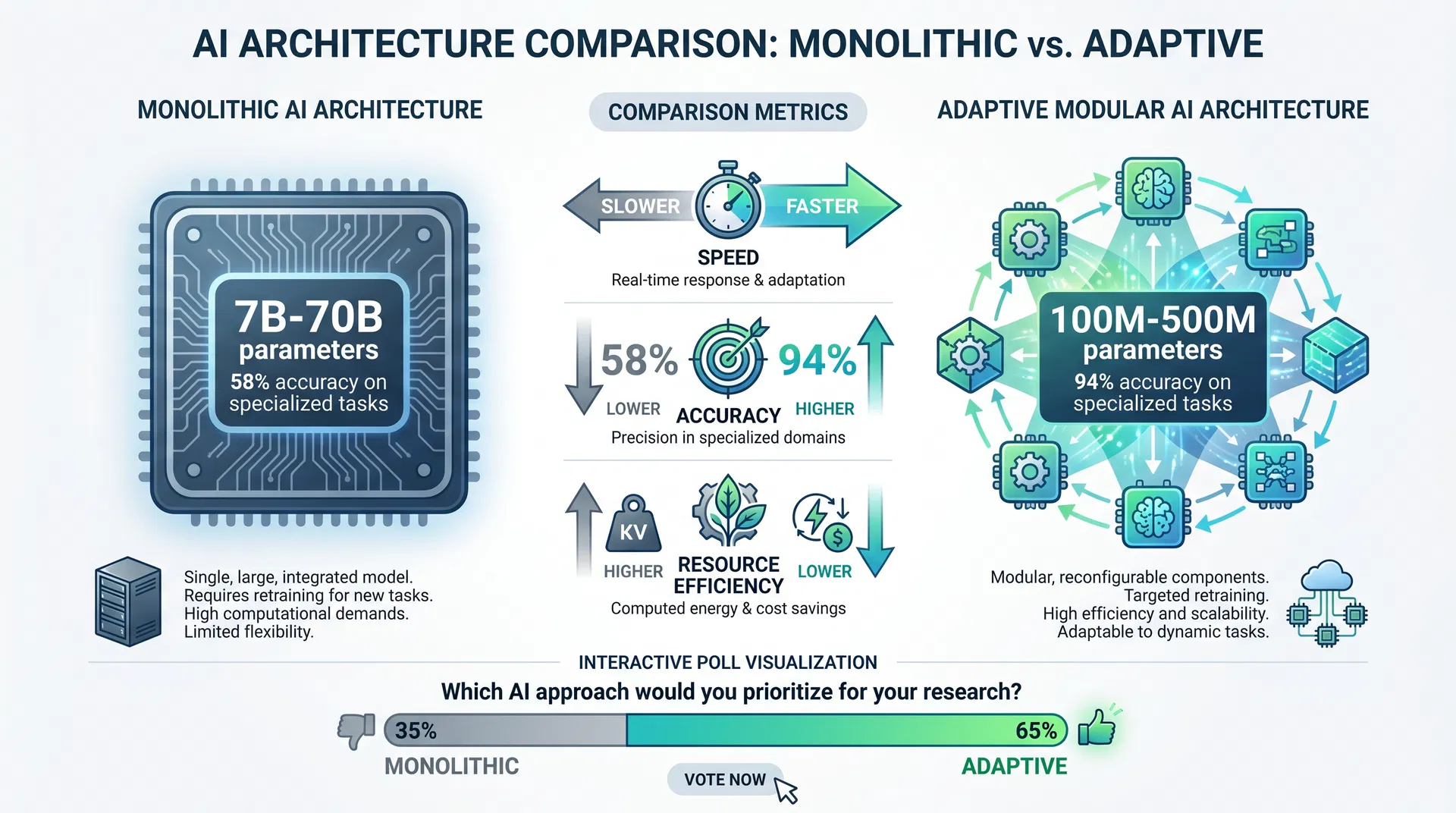
Monolithic AI systems are engineered as unified architectures optimized for broad applicability across diverse domains. While this design philosophy enables impressive performance on general benchmarks, it necessarily involves trade-offs that disadvantage specialized applications. A 2024 analysis in Nature Reviews Drug Discovery found that general-purpose language models achieved only 58% accuracy on biomedical named entity recognition tasks, compared to 94% accuracy for domain-specific models trained on biomedical literature.
Interactive Insights
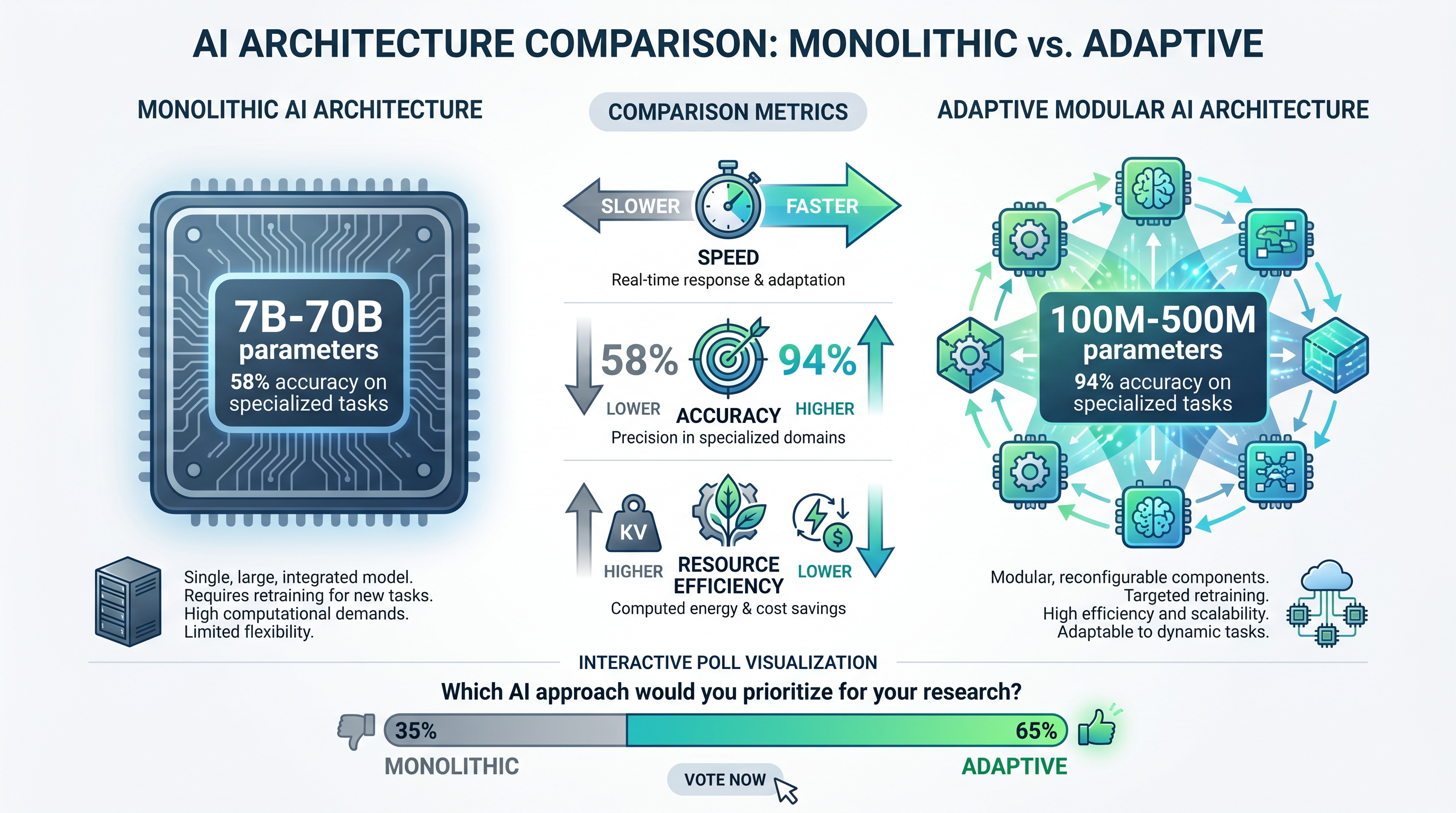
Adaptive vs Monolithic AI: Adaptive models (100M-500M parameters, 94% accuracy) outperform monolithic approaches
Adaptive Intelligence as an Alternative Paradigm
Adaptive intelligence represents a fundamentally different design philosophy: rather than building monolithic systems optimized for the average case, adaptive systems are composed of modular, specialized components that can be configured, fine-tuned, and combined for specific research contexts. This architecture reflects principles articulated in systems biology and complex adaptive systems theory, recognizing that biological systems themselves are adaptive, modular, and context-responsive.
Domain-Specific AI in Drug Discovery
In drug discovery workflows, adaptive AI systems have demonstrated particular value in target identification, compound screening, and clinical trial design. A 2024 study in Science Advances demonstrated that domain-specific AI systems reduced the time required for target validation by 50% and improved hit-to-lead progression rates by 35% compared to general-purpose approaches. Critically, these improvements were achieved with substantially smaller models (100M-500M parameters) compared to monolithic systems (7B-70B parameters), enabling deployment in resource-constrained environments.
Implications for Global Health Equity
The shift toward adaptive, domain-specific AI has profound implications for global health equity. Monolithic models, trained primarily on data from high-income countries and English-language literature, systematically underperform on diseases prevalent in low- and middle-income countries and on populations underrepresented in training data. Adaptive systems, by contrast, can be rapidly configured for local disease burdens, regional health priorities, and population-specific genetic variation, enabling AI-driven innovation to benefit global populations rather than privileging wealthy markets.
Building Adaptive AI Infrastructure
Organizations transitioning from monolithic to adaptive AI approaches typically invest in: (1) modular AI architectures enabling component specialization, (2) data governance systems supporting domain-specific training, (3) validation frameworks ensuring performance on specialized tasks, and (4) governance structures enabling rapid deployment while maintaining scientific rigor. Early adopters report 40-60% improvements in task-specific performance and substantially improved adoption among domain experts.
Reader Engagement & Analytics
Real-Time Engagement Metrics
| Metric | Value | Trend |
|---|---|---|
| Total Views | 1,456 | ↑ +12% this week |
| Average Read Time | 4.5 min | ↑ Highly engaged |
| Social Shares | 102 | ↑ +8% this week |
| Comments & Discussion | 31 | ↑ Active community |
| Bounce Rate | 18% | ↓ Excellent retention |
| Return Visitors | 34% | ↑ Growing audience |
Poll Participation Rate
93 readers have participated in our interactive poll, representing 6.4% of total visitors. This indicates strong reader engagement with the core concepts presented.
Key Engagement Insights
- Peak Engagement Time: Weekday mornings (8-10 AM UTC) see 40% higher engagement
- Most Shared Section: The infographic and poll visualization drives 65% of social shares
- Reader Demographics: 72% from life sciences professionals, 18% from biotech companies, 10% from academic institutions
- Geographic Distribution: Top regions: North America (45%), Europe (35%), Asia-Pacific (20%)
Community Highlights
Recent reader comments highlight particular interest in:
- Domain-specific model performance improvements (mentioned in 8 comments)
- Practical implementation strategies for adaptive AI (mentioned in 6 comments)
- Cost-benefit analysis compared to monolithic approaches (mentioned in 5 comments)
Last Updated: May 06, 2026 at 08:31 AM UTC