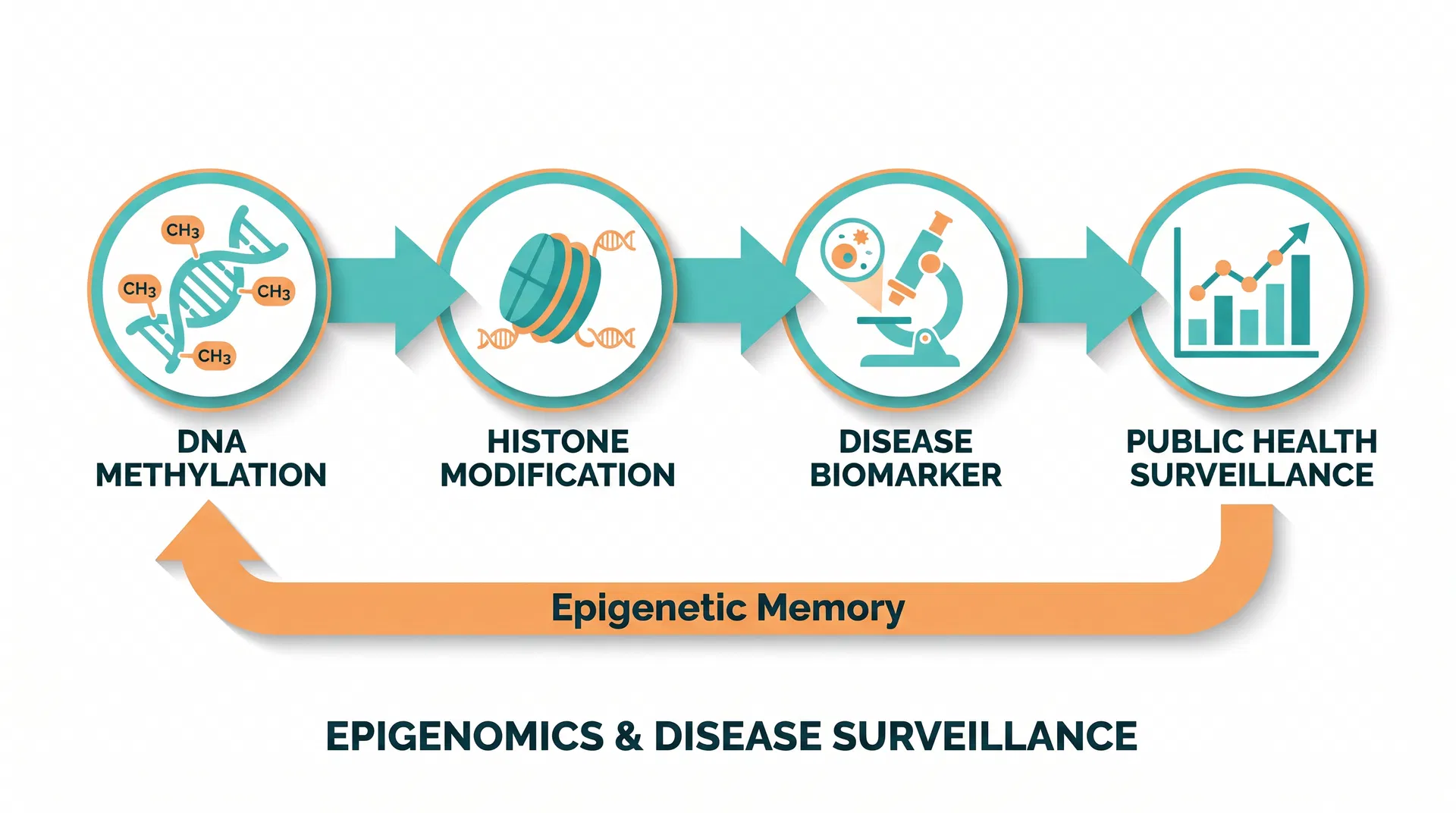
The human genome is often described as a blueprint — a fixed set of instructions that determines biological form and function. This metaphor, while useful, is profoundly incomplete. The genome is not read in isolation but is continuously interpreted through a dynamic layer of chemical modifications — the epigenome — that determines which genes are expressed, in which cells, and under what conditions. These modifications, including DNA methylation, histone modification, and non-coding RNA regulation, are responsive to environmental signals and can persist across cell divisions and, in some cases, across generations. The emerging field of epigenomics is revealing that the epigenome encodes a molecular memory of an organism's history — its exposures, infections, nutritional status, and psychosocial stressors — and that reading this memory offers transformative possibilities for disease surveillance, biomarker discovery, and public health genomics.
The Epigenome: Architecture and Dynamics
DNA methylation — the addition of a methyl group to the 5-carbon position of cytosine residues, predominantly at CpG dinucleotides — is the most extensively studied epigenetic modification. In mammals, approximately 70–80% of CpG sites are methylated in somatic cells, with methylation patterns established during development and maintained through cell division by the DNMT1 methyltransferase. Aberrant methylation — hypermethylation of tumour suppressor gene promoters and global hypomethylation — is a hallmark of cancer and has been exploited in the development of epigenetic biomarkers for cancer detection and monitoring.
Histone modifications — acetylation, methylation, phosphorylation, ubiquitination, and sumoylation of the amino-terminal tails of histone proteins — constitute a second major layer of epigenetic regulation. The combinatorial complexity of histone modifications, sometimes referred to as the "histone code," creates a vast regulatory landscape that modulates chromatin accessibility and transcriptional activity. Chromatin immunoprecipitation followed by sequencing (ChIP-seq) has enabled genome-wide mapping of histone modification patterns, revealing the regulatory logic of cell-type-specific gene expression and the epigenetic dysregulation associated with disease.
Epigenomic Biomarkers of Infectious Disease Exposure
One of the most compelling applications of epigenomics to disease surveillance is the identification of epigenomic signatures of past infectious disease exposure. Infection leaves lasting marks on the epigenome of immune cells — marks that can be detected long after the pathogen has been cleared and that provide information about the nature, timing, and severity of the exposure. This "epigenetic immunological memory" is distinct from, and complementary to, the antibody-based serological memory that underpins conventional infectious disease serosurveillance.
Studies of tuberculosis (TB) have demonstrated that Mycobacterium tuberculosis infection induces specific DNA methylation changes in peripheral blood mononuclear cells (PBMCs) that distinguish active TB from latent infection and from healthy controls. These methylation signatures have potential utility as diagnostic biomarkers in settings where sputum smear microscopy and culture — the current gold standards — are logistically challenging. Similarly, epigenomic studies of malaria have identified methylation changes in erythrocyte precursors and immune cells that correlate with disease severity and may inform the development of epigenetic biomarkers for malaria surveillance in high-transmission settings.
The COVID-19 pandemic has catalysed a wave of epigenomic research into SARS-CoV-2 infection. Studies have identified DNA methylation changes in genes involved in innate immune signalling, interferon response, and coagulation that distinguish severe COVID-19 from mild disease and from healthy controls. Longitudinal epigenomic studies are beginning to characterise the epigenetic basis of Long COVID — the persistent symptoms that affect a significant proportion of SARS-CoV-2 survivors — with implications for understanding the molecular mechanisms of post-acute sequelae and for developing diagnostic and therapeutic strategies.
Epigenetic Clocks and Biological Age in Surveillance
Epigenetic clocks — algorithms that estimate biological age from DNA methylation patterns at a set of CpG sites — represent one of the most striking recent developments in epigenomics. The Horvath clock, the Hannum clock, and subsequent refinements such as PhenoAge and GrimAge use machine learning models trained on large methylation datasets to estimate biological age with remarkable accuracy. Crucially, epigenetic age can diverge from chronological age — a phenomenon termed "epigenetic age acceleration" — and this divergence is associated with a range of adverse health outcomes including cardiovascular disease, cancer, cognitive decline, and all-cause mortality.
From a public health surveillance perspective, population-level epigenetic age acceleration may serve as a sensitive indicator of cumulative environmental and social stressors — including infectious disease burden, nutritional deprivation, air pollution, and psychosocial adversity — that are not captured by conventional health metrics. Incorporating epigenetic clock measurements into population health surveys could provide a more nuanced and mechanistically grounded picture of health inequalities and the biological embedding of social determinants of health.
Environmental Epigenomics and Toxicant Surveillance
The epigenome is exquisitely sensitive to environmental chemical exposures. Endocrine-disrupting chemicals (EDCs) — including bisphenol A (BPA), phthalates, polychlorinated biphenyls (PCBs), and organophosphate pesticides — induce specific patterns of DNA methylation change that can be detected in peripheral blood and that correlate with adverse health outcomes including reproductive dysfunction, metabolic disease, and neurodevelopmental impairment. Epigenomic profiling of exposed populations therefore offers a molecular surveillance tool for environmental health that bridges the gap between exposure assessment and clinical disease endpoints.
Of particular relevance to African biosecurity contexts is the epigenomic impact of mycotoxin exposure. Aflatoxins — produced by Aspergillus flavus and Aspergillus parasiticus on staple crops including maize, groundnuts, and sorghum — are among the most potent naturally occurring carcinogens and are endemic across sub-Saharan Africa. Aflatoxin B1 induces a characteristic G→T transversion at codon 249 of the TP53 tumour suppressor gene, a mutational signature that has been used as a molecular epidemiological marker of aflatoxin exposure in hepatocellular carcinoma studies. Epigenomic approaches — including methylation profiling of aflatoxin-exposed individuals — are now being used to characterise the broader epigenetic landscape of aflatoxin toxicity, with potential implications for early detection of at-risk individuals and populations.
Transgenerational Epigenetic Inheritance and Biosecurity
Perhaps the most philosophically challenging dimension of epigenomics is the evidence for transgenerational epigenetic inheritance — the transmission of epigenetic marks, and the phenotypic effects they encode, across generations through the germline. In model organisms including Caenorhabditis elegans, Drosophila, and rodents, exposure to environmental stressors including toxicants, nutritional deficits, and pathogens has been shown to induce heritable epigenetic changes that persist for multiple generations in the absence of continued exposure. In humans, epidemiological studies of famine cohorts — including the Dutch Hunger Winter and the Swedish Överkalix cohort — have provided suggestive evidence for transgenerational effects of nutritional stress on metabolic health outcomes.
The biosecurity implications of transgenerational epigenetic inheritance are profound and underexplored. If exposure to biological or chemical agents can induce heritable epigenetic changes, the health consequences of a biosecurity incident may extend beyond the directly exposed generation to affect the health of their descendants. This possibility demands that biosecurity risk assessment frameworks incorporate epigenomic considerations — not merely as a tool for detecting current exposures but as a lens for anticipating long-term, multigenerational health consequences.
Conclusion
Epigenomics is transforming our understanding of the relationship between environment, experience, and health. By reading the molecular memory encoded in the epigenome, researchers and public health practitioners can detect past exposures, predict future disease risk, monitor population health at a resolution that conventional surveillance cannot achieve, and begin to understand the mechanisms through which social and environmental determinants of health are biologically embedded. For biosecurity professionals working in Africa and globally, integrating epigenomic approaches into surveillance systems, biomarker development programmes, and risk assessment frameworks represents a frontier of considerable promise — one that demands investment in laboratory capacity, bioinformatic expertise, and interdisciplinary collaboration across molecular biology, epidemiology, and public health.
Policy and Regulatory Framework: Governing Epigenomic Surveillance and Data Sovereignty
Epigenomic surveillance — the systematic monitoring of DNA methylation patterns, histone modifications, and chromatin accessibility as indicators of disease exposure and environmental stress — raises profound questions about data sovereignty, informed consent, and the governance of biological information that existing regulatory frameworks have not resolved. The table below maps the critical gaps.
| Governance Gap | Instrument Affected | Epigenomic Driver |
|---|---|---|
| Epigenomic data not classified as sensitive personal health data in most jurisdictions | GDPR (EU), HIPAA (US), national data protection laws | Epigenetic marks reveal past exposures, lifestyle, and disease susceptibility |
| No international standard for epigenomic data sharing in public health emergencies | WHO IHR (2005), GISAID framework | Epigenome-wide association studies require large cross-border datasets |
| Indigenous epigenomic data not protected under Nagoya Protocol benefit-sharing provisions | CBD, Nagoya Protocol Article 7 | Epigenetic studies of indigenous populations expose community-level health vulnerabilities |
| Epigenomic biomarkers used in insurance and employment decisions without regulatory oversight | ILO conventions, national anti-discrimination law | Methylation clocks predict biological age and disease risk with actuarial precision |
| Environmental epigenomics data from contaminated sites not integrated into national health surveillance | WHO Environmental Health Criteria, Basel Convention | Persistent organic pollutants leave epigenetic signatures detectable decades after exposure |
| Epigenomic research on pathogen virulence factors lacks dual-use review | BWC, NSABB DURC framework | Epigenetic reprogramming of pathogen gene expression can enhance transmissibility |
A Six-Point Policy Reform Agenda for Epigenomic Governance
1. Classify Epigenomic Data as Sensitive Health Data under International Data Protection Frameworks. The WHO's proposed global data governance framework for health should explicitly classify epigenomic data — including DNA methylation profiles, histone modification maps, and chromatin accessibility data — as sensitive health data subject to the highest tier of protection. This classification should be adopted by national data protection authorities and integrated into the GDPR's special category data provisions through a European Data Protection Board opinion.
2. Establish an International Epigenomic Data Commons with Benefit-Sharing Provisions. Building on the model of GISAID for genomic sequence data, an international epigenomic data commons should be established under WHO auspices, with mandatory benefit-sharing provisions requiring that research outputs from data contributed by low- and middle-income country populations be made available to contributing countries' health authorities on a royalty-free basis.
3. Extend Nagoya Protocol Protections to Indigenous Epigenomic Data. The CBD's Ad Hoc Technical Expert Group on Digital Sequence Information should develop guidance clarifying that epigenomic data derived from indigenous community members constitutes a form of traditional knowledge with associated genetic resources, triggering the prior informed consent and benefit-sharing obligations of the Nagoya Protocol. This guidance should be adopted as a COP-MOP decision at the next Conference of the Parties.
4. Prohibit Epigenomic Data Use in Insurance Underwriting and Employment Decisions. The International Labour Organization should develop a supplementary protocol to the Discrimination (Employment and Occupation) Convention (No. 111) prohibiting the use of epigenomic biomarkers — including methylation-based biological age estimates and disease susceptibility scores — in employment, insurance, and credit decisions. National legislation implementing this prohibition should be supported through ILO technical assistance programmes.
5. Integrate Environmental Epigenomics into National Environmental Health Surveillance Systems. WHO Member States should be encouraged, through a World Health Assembly resolution, to integrate environmental epigenomic monitoring into national environmental health surveillance frameworks, using standardised methylation biomarker panels to track population-level exposure to persistent organic pollutants, heavy metals, and air pollution in high-risk communities.
6. Mandate Dual-Use Review for Epigenomic Research on Pathogen Virulence Factors. The NSABB and equivalent national biosafety advisory bodies should extend their DURC review criteria to include epigenomic research that: (a) characterises epigenetic mechanisms controlling pathogen virulence gene expression; (b) develops methods for epigenetic reprogramming of pathogen phenotypes; or (c) identifies epigenetic vulnerabilities in host immune responses that could be exploited to enhance pathogen transmissibility or lethality.
"Epigenomics is the molecular memory of our environment. Governing it responsibly is not a technical challenge — it is a matter of justice, sovereignty, and public health." — Dr. Joseph Odongo Oduor, Genomics and Biosecurity Specialist