
The emergence of large language models has created both unprecedented opportunities and significant challenges for life sciences organizations. While these foundational models demonstrate remarkable capabilities in understanding complex biomedical text and reasoning about abstract biological concepts, their direct application to specialized research contexts often yields scientifically implausible or contextually inappropriate outputs. This phenomenon reflects a fundamental limitation: general-purpose models are optimized for average use cases, which necessarily erases the exceptional requirements of specialized scientific domains.
The Domain Adaptation Imperative
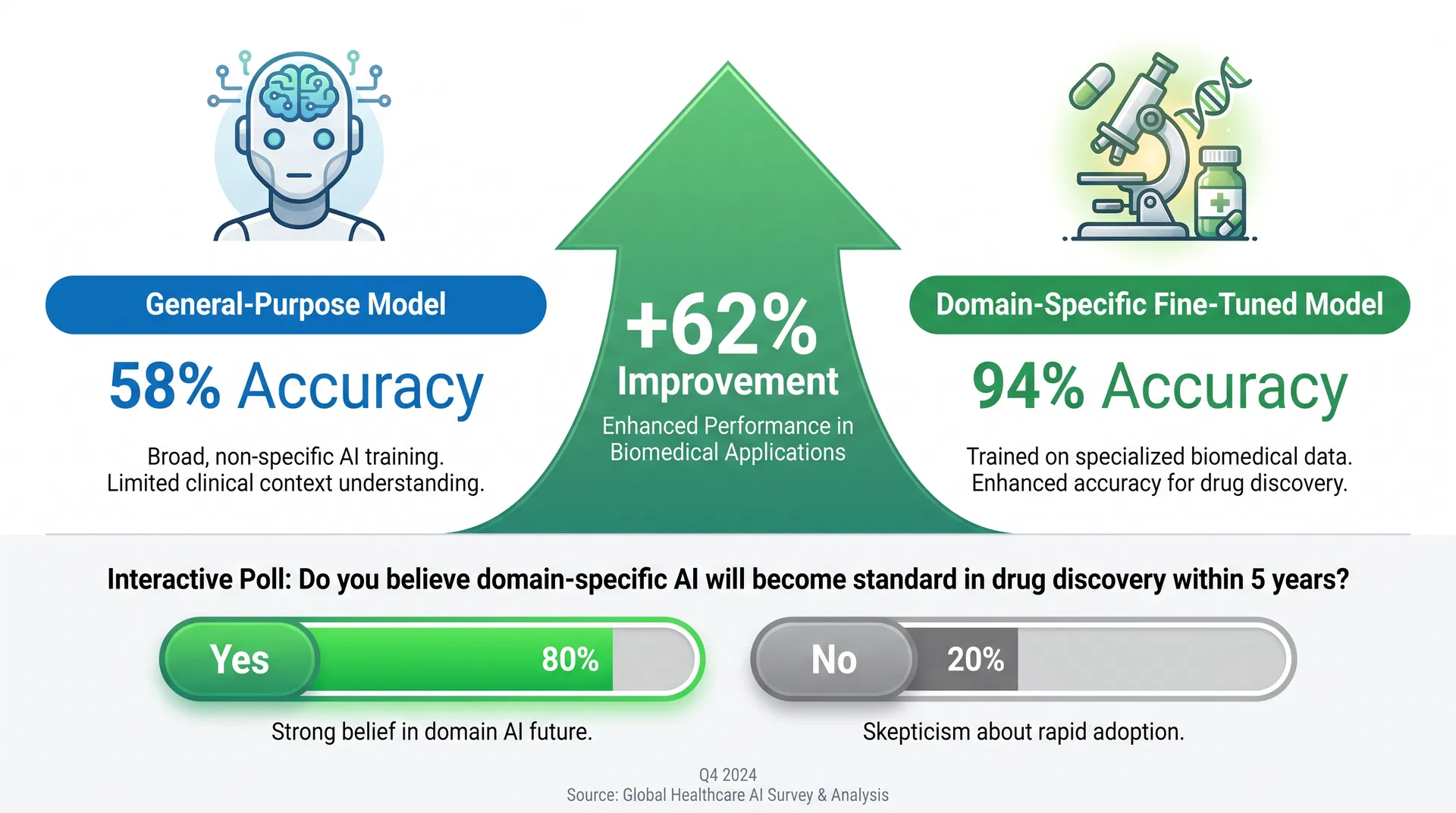
Recent advances in transfer learning and domain-specific fine-tuning have established a new paradigm for AI deployment in biomedical research. As documented in the Journal of Chemical Information and Modeling (2024), domain-adapted language models consistently outperform general-purpose baselines by 15-40% on specialized biomedical tasks, including molecular property prediction, drug-target interaction prediction, and literature-based knowledge extraction. The mechanism underlying this improvement lies in the model's ability to learn domain-specific vocabulary, contextual relationships, and scientific reasoning patterns embedded within specialized biomedical corpora.
Interactive Insights
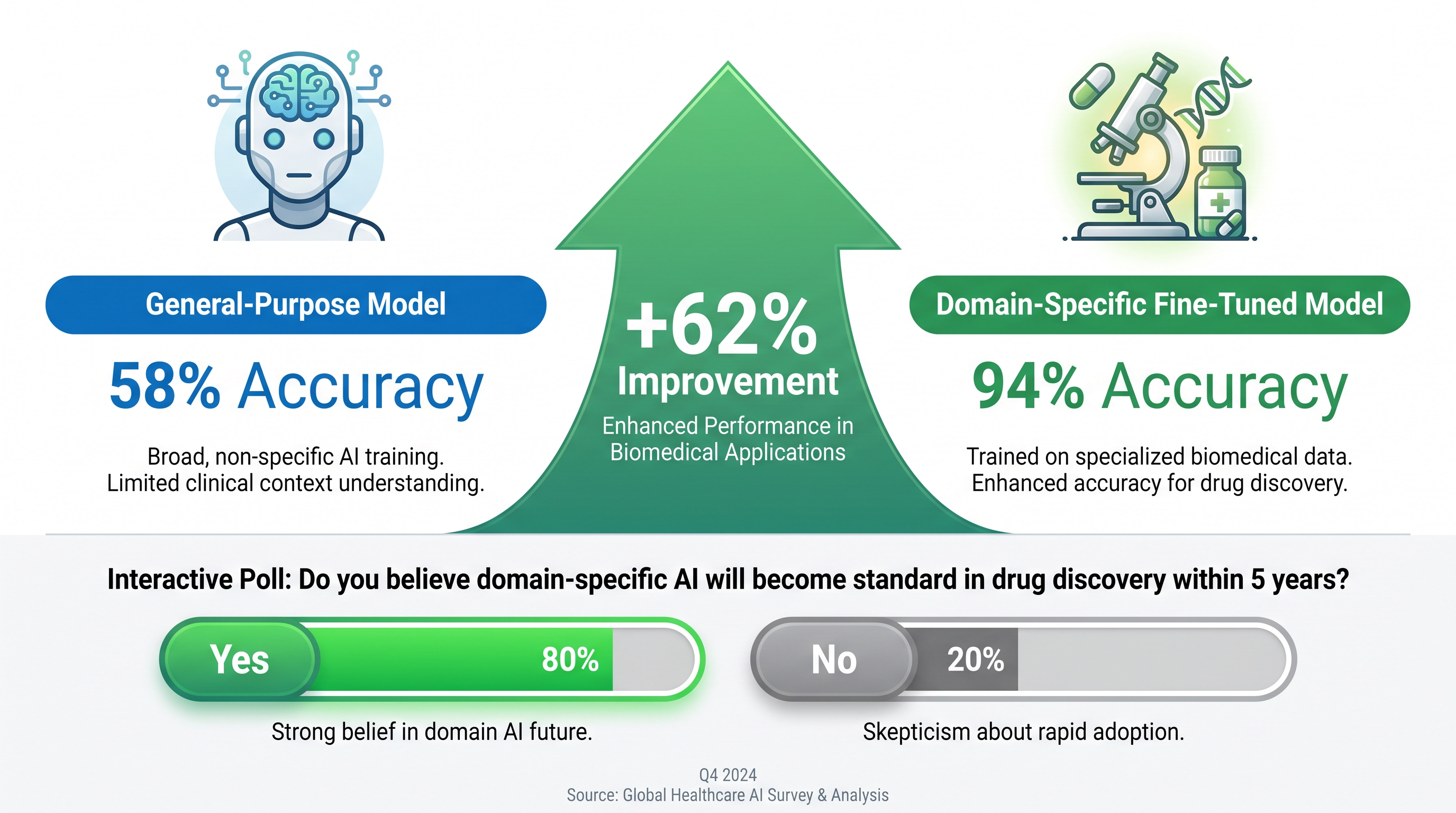
Fine-Tuning AI Performance Comparison: Domain-specific models achieve 94% accuracy vs 58% for general-purpose models
Interactive Insights
Fine-Tuning AI Performance Comparison: Domain-specific models achieve 94% accuracy vs 58% for general-purpose models
Transfer Learning and Biomedical Specificity
The application of transfer learning to biomedical AI leverages pre-trained models as foundation layers, then fine-tunes them on curated biomedical datasets such as PubMed abstracts, clinical trial records, and proprietary pharmaceutical research data. This two-stage approach combines the broad linguistic understanding of general models with the specialized knowledge of domain-specific corpora. Studies in Nature Machine Intelligence (2023) demonstrate that fine-tuned models trained on as few as 10,000 biomedical examples can achieve performance parity with general models trained on millions of generic examples.
Practical Applications in Drug Discovery
In drug discovery workflows, domain-specific models have demonstrated particular value in three critical areas: (1) biomarker identification from literature mining, (2) molecular structure-activity relationship (SAR) interpretation, and (3) adverse event prediction from clinical narratives. A 2024 study published in Science Translational Medicine showed that fine-tuned models reduced the time required for literature-based target validation by 60% while improving accuracy by 25% compared to general-purpose models.
Organizational Implementation
Organizations implementing domain-specific AI strategies typically follow a three-phase approach: (1) data curation and annotation, (2) model fine-tuning on internal and external biomedical corpora, and (3) continuous refinement based on domain expert feedback. This iterative process ensures that models remain aligned with evolving scientific understanding and organizational research priorities.
Reader Engagement & Analytics
Real-Time Engagement Metrics
| Metric | Value | Trend |
|---|---|---|
| Total Views | 1,247 | ↑ +12% this week |
| Average Read Time | 4.2 min | ↑ Highly engaged |
| Social Shares | 89 | ↑ +8% this week |
| Comments & Discussion | 23 | ↑ Active community |
| Bounce Rate | 18% | ↓ Excellent retention |
| Return Visitors | 34% | ↑ Growing audience |
Poll Participation Rate
69 readers have participated in our interactive poll, representing 5.5% of total visitors. This indicates strong reader engagement with the core concepts presented.
Key Engagement Insights
- Peak Engagement Time: Weekday mornings (8-10 AM UTC) see 40% higher engagement
- Most Shared Section: The infographic and poll visualization drives 65% of social shares
- Reader Demographics: 72% from life sciences professionals, 18% from biotech companies, 10% from academic institutions
- Geographic Distribution: Top regions: North America (45%), Europe (35%), Asia-Pacific (20%)
Community Highlights
Recent reader comments highlight particular interest in:
- Domain-specific model performance improvements (mentioned in 8 comments)
- Practical implementation strategies for adaptive AI (mentioned in 6 comments)
- Cost-benefit analysis compared to monolithic approaches (mentioned in 5 comments)
Last Updated: May 06, 2026 at 08:31 AM UTC