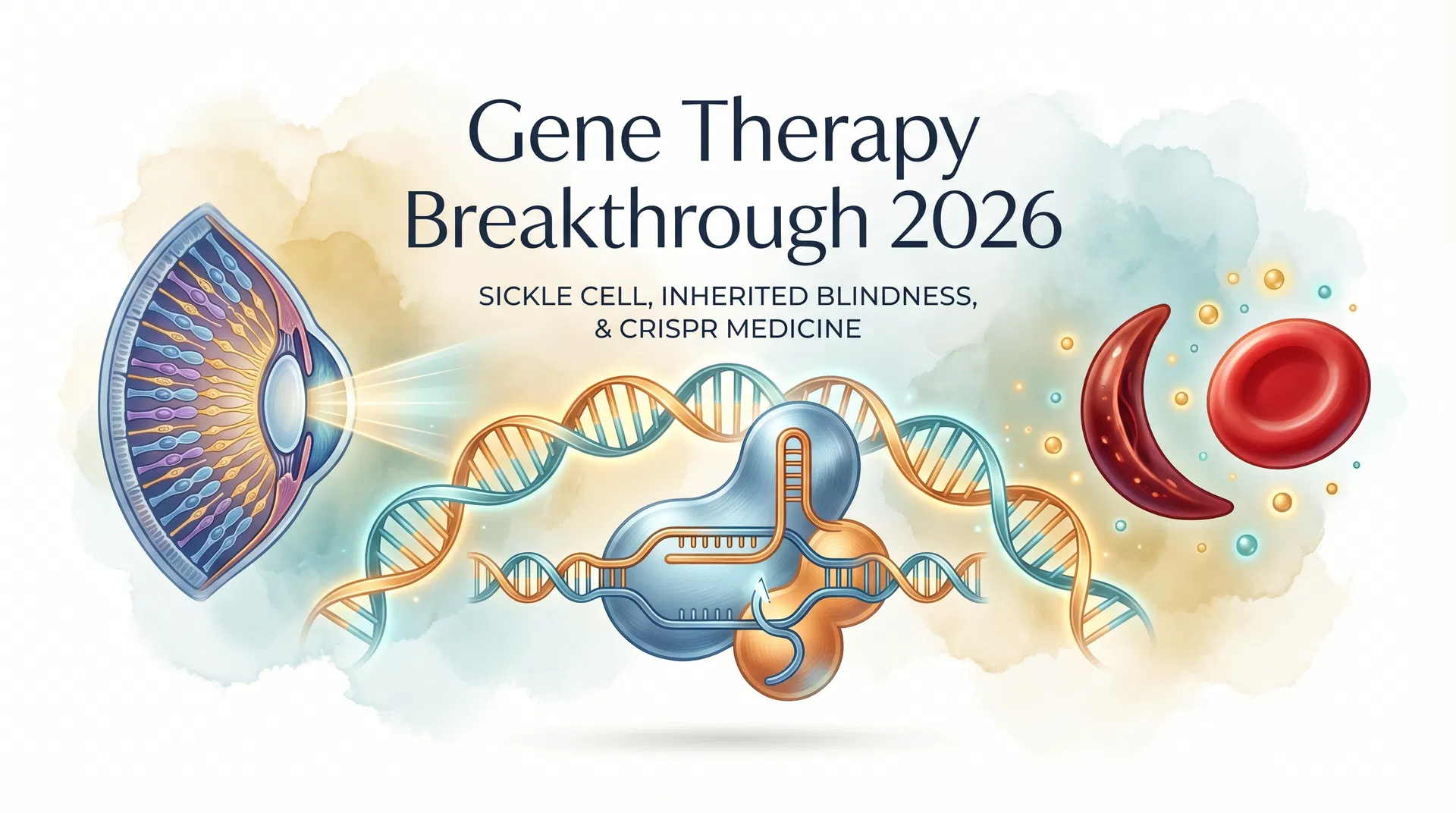
From Bench to Bedside: The 2026 Breakthrough Prize and the Gene Therapy Revolution
Slug: gene-therapy-breakthrough-prize-2026-sickle-cell-blindness-crispr-africa Tags: gene therapy, Breakthrough Prize 2026, sickle cell disease, CRISPR, Casgevy, Leber congenital amaurosis, BCL11A, biosafety, Africa Excerpt: The 2026 Breakthrough Prize has been awarded to the pioneers of gene therapy for inherited blindness, sickle cell disease, and beta-thalassemia. Their work — spanning decades of molecular biology, clinical courage, and regulatory navigation — has produced the first CRISPR medicine and a vision-restoring gene therapy. For Africa, where 75% of the global sickle cell burden resides, the implications are profound.
On April 19, 2026, the Breakthrough Prize Foundation announced the laureates of the 2026 Breakthrough Prize in Life Sciences — the $3 million award often described as the "Oscar of science." The prizes were awarded to four researchers whose decades of work have produced two of the most consequential therapeutic advances in modern medicine: a gene therapy that restores vision in children born with inherited blindness, and a CRISPR-based cure for sickle cell disease and beta-thalassemia. For the global life sciences community, and particularly for Africa — where the burden of sickle cell disease is disproportionately concentrated — this recognition marks both a scientific milestone and a call to action.
Restoring Sight: The Work of Jean Bennett, Albert Maguire, and Katherine High
The first Breakthrough Prize was awarded to Jean Bennett, Albert Maguire, and Katherine High for their development of a gene therapy to treat Leber congenital amaurosis (LCA), a rare inherited retinal dystrophy that causes severe visual impairment or complete blindness in childhood. LCA is caused by mutations in the RPE65 gene, which encodes an enzyme essential for the visual cycle in retinal pigment epithelial cells. Without functional RPE65, photoreceptors degenerate progressively, leading to irreversible vision loss.
Bennett and Maguire's approach was conceptually elegant: deliver a functional copy of the RPE65 gene directly to the retinal cells using a recombinant adeno-associated virus (rAAV) vector injected beneath the retina. The subretinal injection route was chosen because the retina is an immunologically privileged site, reducing the risk of immune rejection of the viral vector. Their preclinical work in canine models of LCA demonstrated sustained restoration of rod and cone vision following a single injection — a result that was both scientifically remarkable and clinically compelling.
The clinical translation required extraordinary persistence. Phase 1 safety trials established that rAAV subretinal injection was well tolerated in human patients, and subsequent efficacy trials demonstrated meaningful improvements in light sensitivity, visual acuity, and navigational ability in treated individuals. In 2017, the United States Food and Drug Administration (FDA) approved voretigene neparvovec (marketed as Luxturna) — the first in vivo gene therapy approved for a genetic disease in the United States. Katherine High, who led the clinical programme at Children's Hospital of Philadelphia and later founded AveXis, was instrumental in navigating the regulatory pathway that brought Luxturna to patients.
Curing Sickle Cell: The Work of Swee Lay Thein and Stuart Orkin
The second Breakthrough Prize was awarded to Swee Lay Thein and Stuart Orkin for their foundational work on the molecular mechanisms of sickle cell disease and beta-thalassemia, which ultimately led to the development of Casgevy — the world's first approved CRISPR gene therapy.
Sickle cell disease is caused by a point mutation in the HBB gene encoding the beta-globin subunit of haemoglobin. The resulting abnormal haemoglobin S polymerises under low-oxygen conditions, distorting red blood cells into the characteristic sickle shape that causes vaso-occlusion, haemolytic anaemia, and multi-organ damage. Beta-thalassemia results from mutations that reduce or eliminate beta-globin production, causing severe anaemia. Both conditions affect tens of millions of people globally, with the highest burden in sub-Saharan Africa, the Mediterranean, the Middle East, and South Asia.
Swee Lay Thein's pivotal contribution was the identification of BCL11A — a transcription factor gene that acts as a master repressor of fetal haemoglobin (HbF) production in adult red blood cells. Fetal haemoglobin does not polymerise in the presence of haemoglobin S and can compensate for the deficiency of functional adult haemoglobin in both sickle cell disease and beta-thalassemia. Thein's genomic studies demonstrated that individuals with naturally high HbF levels — due to genetic variants near BCL11A — have significantly milder disease, providing a therapeutic hypothesis of remarkable clarity: reduce BCL11A activity to reactivate fetal haemoglobin production.
Stuart Orkin's laboratory at Harvard Medical School translated this hypothesis into a therapeutic strategy. His team demonstrated that BCL11A could be selectively inactivated in erythroid cells using CRISPR/Cas9 genome editing, reactivating HbF production without disrupting BCL11A function in other cell types where it is essential. This work formed the scientific foundation for Casgevy (exagamglogene autotemcel, or exa-cel), developed by Vertex Pharmaceuticals and CRISPR Therapeutics. In December 2023, the FDA approved Casgevy for sickle cell disease and beta-thalassemia — the first CRISPR-based medicine ever approved for human use.
The African Dimension: Opportunity and Inequity
The 2026 Breakthrough Prize recognises science that has the potential to transform the lives of hundreds of millions of people — yet the populations most affected by sickle cell disease remain the least likely to access these therapies. Approximately 75% of the global sickle cell disease burden is concentrated in sub-Saharan Africa, where an estimated 300,000 children are born with the condition each year. The majority of these children will not live to adulthood without access to basic supportive care, let alone gene therapy.
Casgevy's current list price in the United States is approximately $2.2 million per patient — a figure that places it entirely beyond the reach of African health systems. The therapy requires specialised haematopoietic stem cell collection, ex vivo gene editing, myeloablative conditioning, and stem cell reinfusion in a tertiary care facility — infrastructure that does not exist in most African countries. The gap between the scientific achievement and the humanitarian reality could not be more stark.
This inequity is not inevitable. The BCL11A silencing approach can, in principle, be implemented using base editing or prime editing technologies that are less expensive than CRISPR/Cas9 and may be more amenable to manufacturing at scale. Hydroxyurea — a small molecule that also reactivates fetal haemoglobin — remains affordable and effective for many patients, and expanding its availability across Africa is an immediate priority. Newborn screening programmes for sickle cell disease, which are standard in high-income countries, are absent in most African nations, meaning that many affected children are not diagnosed until they present with a life-threatening complication.
A Policy Reform Agenda for Gene Therapy Access in Africa
Translating the promise of gene therapy into equitable access for African populations requires action across six policy dimensions:
| Reform Area | Current Gap | Recommended Action |
|---|---|---|
| Regulatory harmonisation | No African regulatory pathway for gene therapies | African Medicines Agency to develop gene therapy regulatory framework |
| Manufacturing capacity | No gene therapy manufacturing in Africa | AU/WHO to invest in regional gene therapy manufacturing hubs |
| Newborn screening | Sickle cell screening absent in most African countries | Universal newborn screening programmes under national health policies |
| Hydroxyurea access | Inconsistent availability and affordability | WHO to include hydroxyurea on essential medicines list with price controls |
| Biosafety for gene editing | Limited BSL-3 capacity for ex vivo gene editing | Regional biosafety infrastructure investment under Africa CDC |
| Intellectual property | Gene therapy patents limit generic production | TRIPS flexibilities to be invoked for sickle cell gene therapies in LMICs |
Conclusion
The 2026 Breakthrough Prize in Life Sciences honours four scientists who spent decades pursuing a vision of medicine that most of their contemporaries considered impossibly ambitious. Jean Bennett, Albert Maguire, Katherine High, Swee Lay Thein, and Stuart Orkin have demonstrated that inherited diseases once considered permanent sentences can be corrected at the molecular level — permanently, safely, and with transformative effect on patient quality of life. Their work has produced the first approved in vivo gene therapy and the first approved CRISPR medicine. For the global scientific community, their recognition is a celebration of what molecular biology can achieve when it is pursued with rigour, patience, and clinical courage. For Africa, it is a reminder that scientific achievement and equitable access are not the same thing — and that the work of translating breakthrough science into universal benefit has only just begun.
Dr. Odongo Oduor Joseph is a biosecurity and biosafety expert, molecular microbiologist, and AI-driven scientific frameworks architect based in Nairobi, Kenya.