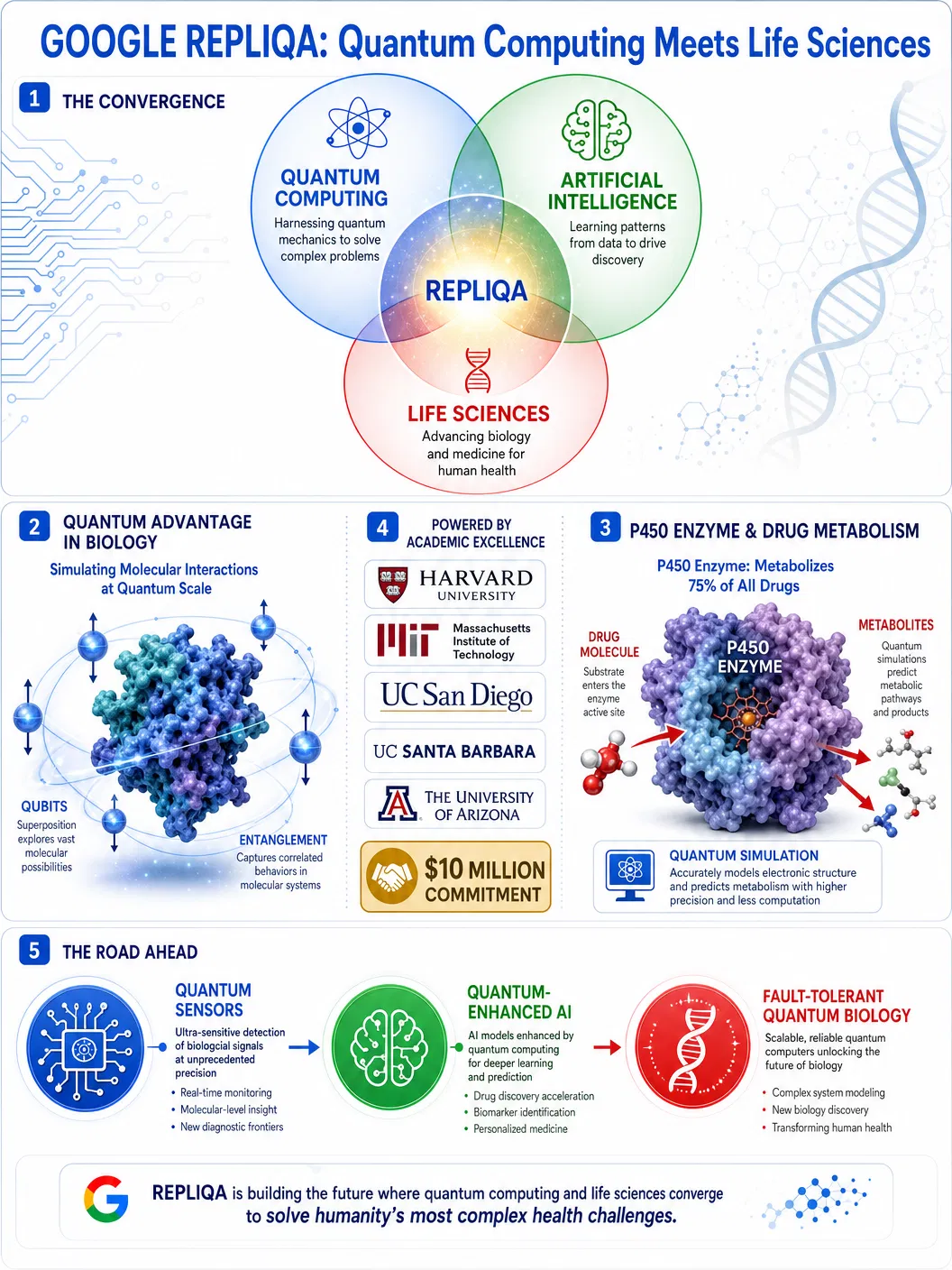
On 11 May 2026, Google announced the launch of REPLIQA — the Research Program at the Intersection of Life Sciences & Quantum AI — a $10 million initiative that represents one of the most ambitious attempts yet to apply quantum computing to the fundamental challenges of biology and medicine. The programme funds research at five of the world’s leading academic institutions: Harvard University, the Massachusetts Institute of Technology, the University of California San Diego, the University of California Santa Barbara, and the University of Arizona.
The announcement, authored by Hartmut Neven, Founder and Lead of Google Quantum AI, articulates a vision that has been building for years but is now reaching a critical inflection point. The core insight is deceptively simple: biological processes — protein folding, enzymatic catalysis, drug-receptor interactions, cellular signalling — are fundamentally quantum mechanical phenomena. They involve electrons tunnelling through energy barriers, quantum coherence in photosynthetic complexes, and spin dynamics in radical pair mechanisms. Classical computers can approximate these processes, but they cannot simulate them with the fidelity that quantum computers theoretically can.
“Understanding human biology and health at the molecular level is one of science’s greatest challenges,” Neven wrote. “Biological processes, like how a protein folds or how a cell reacts to a new drug, involve incredibly complex interactions at the atomic level. Classical computers often struggle to accurately simulate these interactions. Quantum technologies, however, operate using the very same quantum mechanics that govern these molecules.”
The programme identifies several immediate research priorities. Quantum sensors — devices that exploit quantum superposition and entanglement to achieve measurement precision beyond classical limits — can observe biological processes at resolutions previously impossible. Recent experiments have demonstrated that quantum spin states may play functional roles in cellular biology, suggesting that life itself may exploit quantum effects in ways we are only beginning to understand.
For drug discovery, the implications are profound. One of the programme’s highlighted use cases is the simulation of cytochrome P450 enzymes — a family of proteins responsible for metabolising approximately seventy-five percent of all pharmaceutical drugs. Accurately modelling P450 behaviour is critical for predicting drug interactions, toxicity, and efficacy, yet the quantum mechanical complexity of these enzymes exceeds what classical supercomputers can reliably calculate. A fault-tolerant quantum computer could, in principle, simulate P450 dynamics with chemical accuracy, potentially transforming how drugs are designed and optimised.
The $10 million commitment, funded through Google.org, is structured as a foundational research effort rather than a product-oriented programme. This distinction is important. Neven is explicit that REPLIQA “will not see results overnight” but is instead focused on “building the essential tools — such as quantum sensors and quantum-enhanced AI algorithms — needed to make future breakthroughs possible.” The programme represents a bet on the long-term convergence of three exponentially advancing fields: quantum hardware, artificial intelligence, and molecular biology.
The choice of partner institutions reflects the interdisciplinary nature of the challenge. Harvard brings expertise in quantum chemistry and chemical biology. MIT contributes leadership in quantum information science and synthetic biology. UC San Diego offers strength in computational biophysics and genomics. UC Santa Barbara houses one of the world’s leading quantum hardware programmes. The University of Arizona brings expertise in quantum optics and biophysics.
The timing of REPLIQA is significant. Google’s Willow quantum processor, announced in late 2025, demonstrated below-threshold error correction for the first time — a milestone that brings fault-tolerant quantum computing measurably closer to reality. While current quantum computers remain too noisy for practical biological simulations, the trajectory of hardware improvement suggests that useful quantum advantage in chemistry and biology could emerge within the next five to ten years.
For the life sciences community, REPLIQA signals that the quantum era is no longer a distant abstraction. The tools being developed today — quantum-enhanced machine learning for molecular property prediction, quantum sensors for single-molecule imaging, hybrid classical-quantum algorithms for electronic structure calculations — will define the next generation of biological discovery. The question is no longer whether quantum computing will impact life sciences, but how quickly and how profoundly.
References: Neven H. REPLIQA: Quantum Computing for Life Sciences. Google Blog, 11 May 2026. Google.org Commitment Announcement. HPC Wire, 11 May 2026. Investing.com, 11 May 2026.