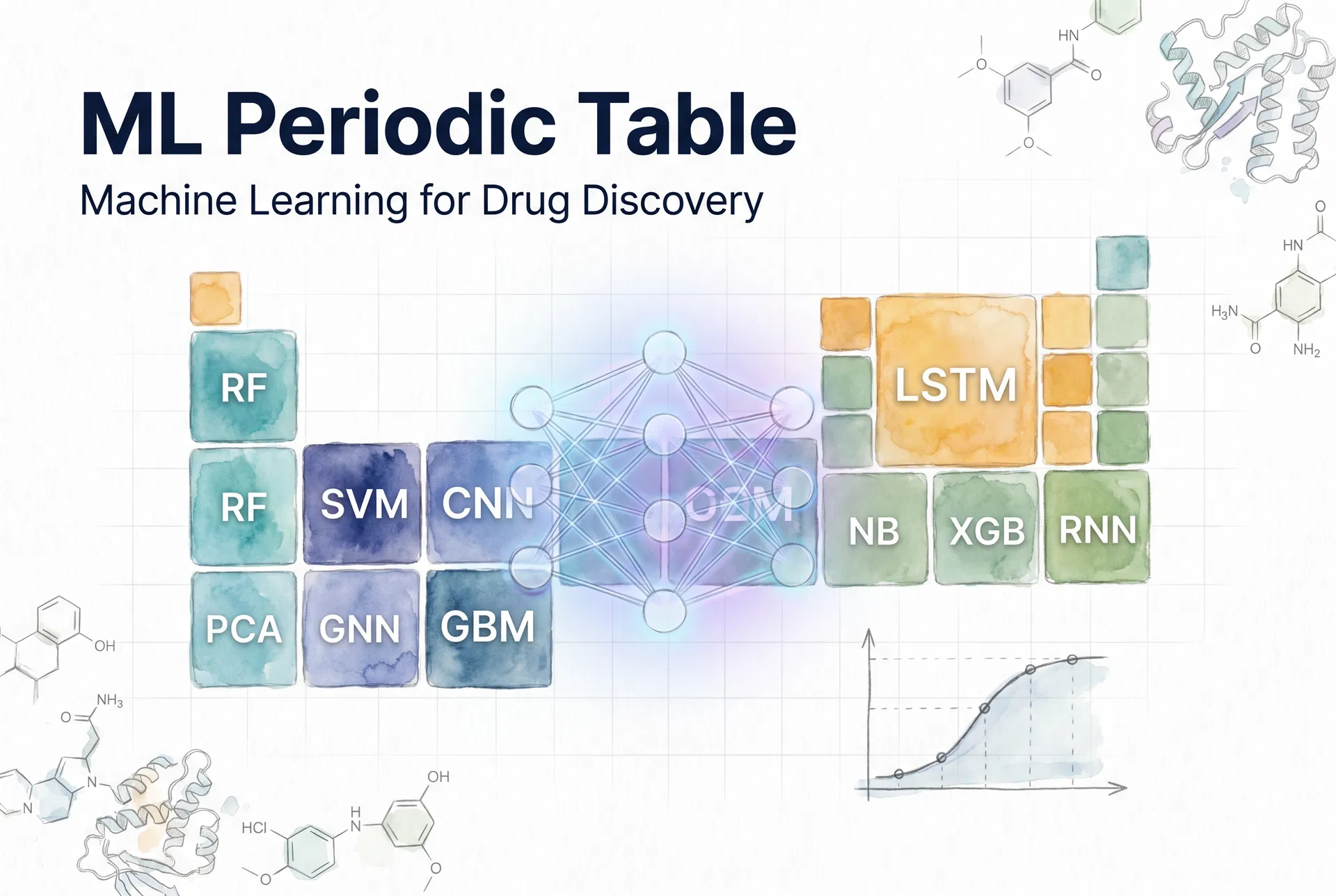
When Dmitri Mendeleev published his periodic table of elements in 1869, he did something that went far beyond cataloguing known substances. He imposed an organising logic on apparent chaos — revealing patterns, predicting unknowns, and giving chemists a shared vocabulary for reasoning about matter. More than 150 years later, Invitron has applied the same conceptual ambition to the bewildering landscape of machine learning: its ML Periodic Table is an interactive browser of more than 40 machine learning and deep learning algorithms, organised by category, task type, and biological application.
For life scientists who are not machine learning specialists — which describes the majority of preclinical researchers — the ML Periodic Table represents something genuinely useful: a curated, navigable map of a field that can otherwise feel impenetrable.
The Problem It Solves
The machine learning literature relevant to drug discovery spans hundreds of algorithm families: random forests, gradient boosting machines, support vector machines, convolutional neural networks, recurrent neural networks, graph neural networks, transformer architectures, and many more. Each has strengths and weaknesses that depend on the nature of the data, the size of the training set, the dimensionality of the feature space, and the specific prediction task. Choosing the wrong algorithm does not merely produce suboptimal results — it can produce confidently wrong results, which in a drug discovery context can mean wasted years and failed clinical trials.
Invitron's ML Periodic Table addresses this by organising algorithms along two axes: category (supervised, unsupervised, reinforcement learning, deep learning, ensemble methods) and task type (classification, regression, clustering, dimensionality reduction, sequence modelling). Each algorithm entry includes a description of its optimal use cases, its computational requirements, and — critically — its integration pathway with the DART analysis framework.
From Algorithm to Experiment
The ML Periodic Table is not a passive reference. Researchers can select any algorithm directly from the browser and apply it to enhance their DART predictions. This means that a researcher studying cardiovascular drug response in an ApoE-/- mouse model can select a gradient boosting regressor, upload their own dose-response data via the Upload & Train module, and retrain the platform's base model with their experimental observations — producing a personalised predictive model that is more accurate for their specific compound and strain than the platform's default parameters.
This LoRA (Low-Rank Adaptation) fine-tuning capability — accessible via the dedicated LoRA Studio module — is particularly significant. LoRA is a technique originally developed for fine-tuning large language models with minimal computational overhead; Invitron has adapted it for biological prediction models, allowing researchers to personalise platform models with small, domain-specific datasets without requiring GPU infrastructure or machine learning expertise.
Algorithms Across Disease Areas
The platform's 40+ algorithms are mapped across Invitron's eight disease areas: oncology, CNS/neurological, cardiovascular, metabolic/diabetes, inflammatory/autoimmune, infectious disease, respiratory/pulmonary, and musculoskeletal. This cross-mapping means that a researcher can filter the ML Periodic Table not just by algorithm type but by the disease context most relevant to their work — a feature that significantly reduces the cognitive load of algorithm selection.
For oncology researchers, for example, the platform highlights algorithms with strong performance on high-dimensional genomic feature spaces and imbalanced class distributions — common characteristics of cancer drug response datasets. For infectious disease researchers, it foregrounds sequence-based models suited to viral protein structure prediction and antiviral compound screening.
The Bigger Picture
Invitron's ML Periodic Table reflects a broader shift in how the life sciences community is beginning to think about artificial intelligence: not as a black box that produces outputs, but as a structured toolkit that researchers can understand, select from, and customise. By making algorithm selection transparent and biologically contextualised, Invitron is helping to build a generation of researchers who are not merely consumers of AI outputs but informed practitioners of computational biology.
The platform is accessible at https://www.invitron.org. For researchers interested in integrating machine learning into their preclinical workflows, the ML Periodic Table is an excellent starting point.