Mirror Life in the Context of AI: Convergent Risks at the Frontier of Biology
In December 2024, a group of 38 scientists published a landmark paper in Science under the title "The Biosecurity Risks of Mirror Life." Their conclusion was stark: the creation of a mirror bacterium — an organism built entirely from D-amino acids and L-sugars, the molecular mirror images of the building blocks of all known life — would pose an existential threat to the biosphere. Not a manageable risk. Not a risk that could be contained by existing biosafety frameworks. An existential threat.
The paper was unusual in its directness, and it prompted an immediate response from the scientific community, biosecurity organisations, and policymakers. But it also raised a question that the paper itself did not fully address: what happens to the mirror life risk landscape when you add artificial intelligence?
The answer, as this post will argue, is that AI dramatically accelerates the timeline to mirror life capability, expands the range of actors who could plausibly pursue it, and simultaneously offers some of the most powerful tools available for detecting and responding to a mirror life release. Understanding this convergence is essential for anyone working at the intersection of biotechnology, biosecurity, and AI governance.
The Biology of Mirror Life: A Brief Primer
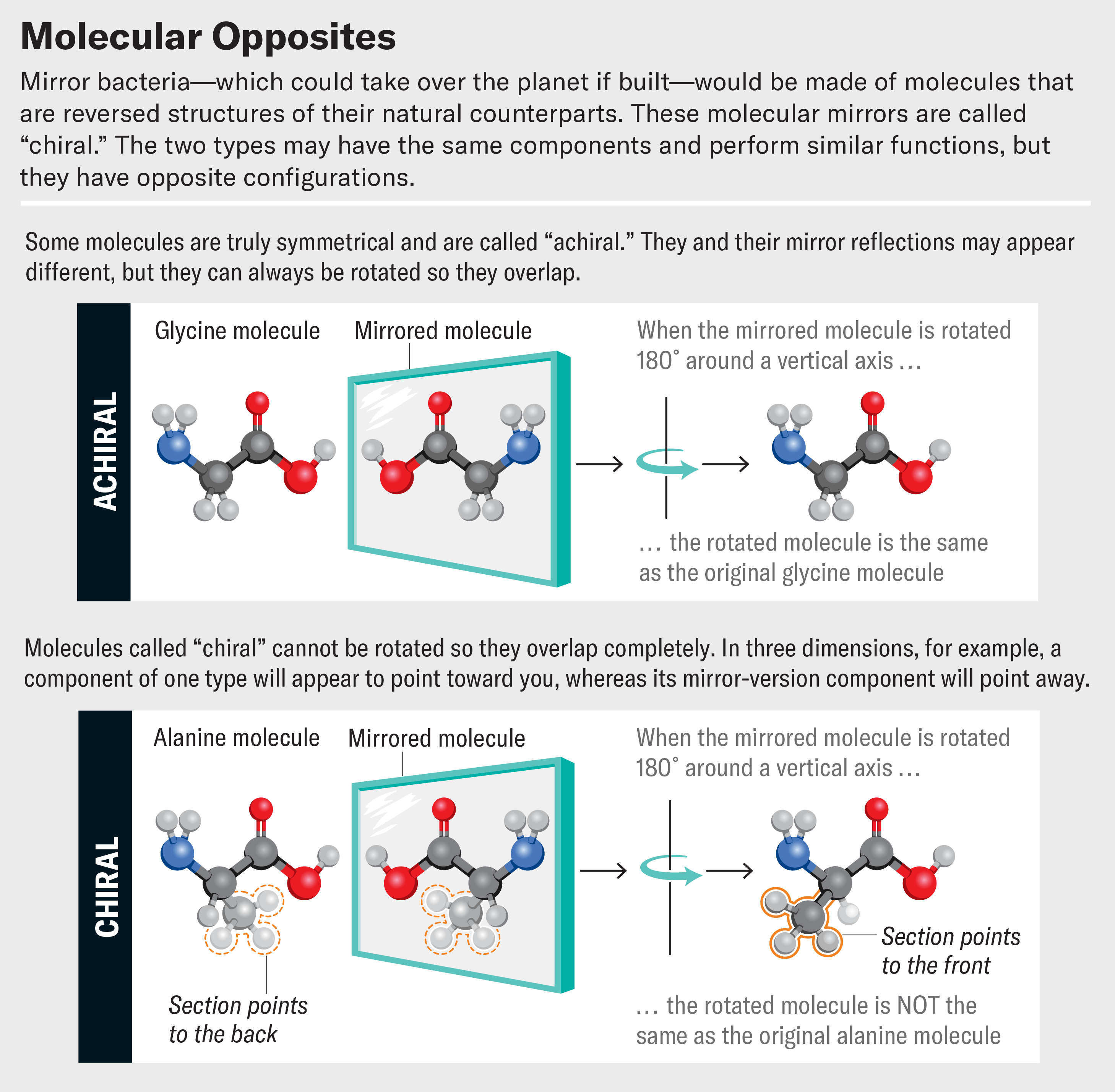
All known life on Earth uses the same molecular chirality: L-amino acids (left-handed) and D-sugars (right-handed). This chirality is not incidental — it is deeply embedded in the molecular machinery of life. Enzymes, ribosomes, immune receptors, and cell surface proteins are all exquisitely tuned to interact with molecules of the correct handedness. A molecule of the opposite chirality — a D-amino acid or an L-sugar — is typically invisible to these systems.
A mirror bacterium would be composed entirely of D-amino acids and L-sugars. Its proteins would fold into mirror-image structures. Its DNA (or rather, its L-DNA) would carry the same genetic information but in a mirror-image double helix. Its ribosomes would translate mirror-image codons into mirror-image proteins. It would be, in every meaningful sense, a living organism — capable of metabolism, replication, and evolution — but built from the molecular mirror image of all known life.
The biosafety implications of this are profound. A mirror bacterium would be invisible to the immune system — immune recognition depends on the ability of antibodies, T-cell receptors, and pattern recognition receptors to bind to specific molecular structures tuned to natural-chirality molecules. A mirror bacterium's surface proteins would be composed of D-amino acids and L-sugars — structures that immune receptors cannot recognise.
It would be resistant to all known antibiotics — antibiotics work by targeting specific molecular structures in bacterial cells (the peptidoglycan cell wall, the ribosome, DNA gyrase), all composed of natural-chirality molecules. Mirror-image versions of these targets would render every known antibiotic ineffective.
It would be resistant to predation and parasitism — bacteriophages, protists, and other microbial predators do so through specific molecular recognition events. A mirror bacterium's surface would be unrecognisable to these predators, potentially allowing it to proliferate without the ecological checks that constrain natural bacteria.
The Current State of Mirror Life Research
Creating a full mirror bacterium remains far beyond current technical capabilities. The synthesis of a complete mirror ribosome requires the chemical synthesis of dozens of mirror-image ribosomal proteins and ribosomal RNA molecules, followed by their assembly into a functional complex. However, progress is being made: mirror-image versions of individual proteins have been synthesised, mirror-image DNA polymerases have been demonstrated, and mirror-image ribozymes have been created. The field of mirror biology is advancing, and the trajectory of that advance is being accelerated by AI.
How AI Accelerates the Path to Mirror Life
Protein structure prediction for mirror proteins. AlphaFold2 and its successors can predict the three-dimensional structure of proteins from their amino acid sequence with near-experimental accuracy. Crucially, the laws of physics that govern protein folding are symmetric with respect to chirality: a D-amino acid protein will fold into the exact mirror image of the corresponding L-amino acid protein. This means that AlphaFold2 can, in principle, be used to predict the structure of any mirror protein — and to design mirror proteins with desired functions — without any modification. The entire protein structure prediction capability of modern AI is, by default, applicable to mirror life research.
Automated synthesis planning. AI tools for retrosynthetic analysis (such as IBM RXN and AiZynthFinder) can plan chemical synthesis routes for complex molecules, including the D-amino acids and L-sugars required for mirror life research. As these tools improve, the chemical synthesis barriers to mirror life research will decrease.
Ribosome design and optimisation. The mirror ribosome is the central technical challenge for mirror life. AI tools for RNA structure prediction (such as RoseTTAFold2NA and AlphaFold3) and protein-RNA interaction modelling could significantly accelerate the design of functional mirror ribosomes by predicting how mirror-image ribosomal components will interact and identifying design modifications that improve assembly and function.
Accelerated literature synthesis. Large language models can synthesise the relevant scientific literature on mirror biology, chemical synthesis, and ribosome assembly far more rapidly than any human researcher. This lowers the barrier to entry for researchers who are not specialists in all the relevant fields.
AI as a Tool for Mirror Life Detection and Response
The same AI capabilities that accelerate the path to mirror life also offer powerful tools for detection and response — but only if they are deliberately developed and deployed for this purpose.
AI-powered metagenomic analysis can identify unusual sequences in environmental samples. Mirror DNA (L-DNA) would not be amplified by standard PCR using natural-chirality polymerases, but it could potentially be detected by sequencing methods that do not rely on enzymatic amplification, such as nanopore sequencing. AI models trained to identify anomalous sequence patterns could flag potential mirror life contamination in environmental surveillance data.
AI models trained on ecological data could simulate the spread and impact of a mirror organism in different ecosystems, informing containment and response strategies. If a mirror pathogen were released, AI tools for protein design (such as RFdiffusion and ProteinMPNN) could accelerate the development of mirror-image countermeasures — but only if they have been adapted to work with D-amino acid proteins, which requires deliberate investment.
Governance Implications
The convergence of mirror life and AI creates a governance challenge of unusual complexity. Mirror life research is not currently regulated as a select agent or dual-use research of concern (DURC) in most jurisdictions, because no mirror organism exists and the technical barriers remain high. But the trajectory of AI-assisted biological research suggests that these barriers will fall faster than governance frameworks can adapt.
Several governance interventions are urgently needed. The existing DURC framework should be extended to cover research that makes significant progress toward mirror life capability — including the synthesis of functional mirror ribosomes or mirror polymerases. International coordination through the BWC, the WHO, and the Convention on Biological Diversity is essential. AI developers must be made aware of the mirror life risk and the ways in which their tools contribute to it, incorporating mirror life risk into the biosecurity evaluation of AI models with significant biological capabilities.
Conclusion
Mirror life and artificial intelligence are two of the most consequential technological frontiers of our time. Their convergence creates risks that are qualitatively different from those posed by either technology alone — risks that are global in scope, potentially irreversible in consequence, and advancing faster than the governance frameworks designed to manage them. Addressing these risks requires a combination of proactive regulation, international coordination, investment in detection and response capabilities, and sustained engagement between the biosecurity community and the AI research community. The 2024 Science paper was a warning. The response to that warning will define whether mirror life remains a theoretical risk or becomes a practical one.