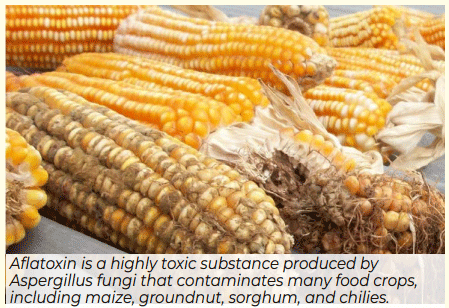
Mycotoxin Biosecurity in Sub-Saharan Africa: The Role of Genomics and AI
By Dr. Odongo Oduor Joseph | Biosecurity & Biosafety Expert | Molecular Microbiologist | AI, Data Informatics & Scientific Frameworks Architect
In the global conversation about biosecurity, the focus tends to fall on dramatic threats — engineered pathogens, pandemic viruses, deliberate bioterrorism. Yet one of the most persistent and consequential biosecurity challenges facing Sub-Saharan Africa operates largely in silence, embedded in the staple foods that hundreds of millions of people depend on every day. Mycotoxins — toxic secondary metabolites produced by filamentous fungi — contaminate an estimated 25 percent of the world's food supply and cause billions of dollars in agricultural losses annually. In Sub-Saharan Africa, where maize, groundnuts, sorghum, and cassava form the nutritional backbone of food systems, mycotoxin contamination is not merely an agricultural problem. It is a public health crisis, a food security threat, and a biosecurity challenge that demands the full force of modern genomic and artificial intelligence tools.
Understanding the Threat: Mycotoxins and Their Producers
The mycotoxin threat in Sub-Saharan Africa is dominated by aflatoxins — a group of highly toxic, carcinogenic compounds produced primarily by Aspergillus flavus and Aspergillus parasiticus. Aflatoxin B1 is the most potent naturally occurring carcinogen known to science, classified as a Group 1 human carcinogen by the International Agency for Research on Cancer. Chronic low-level exposure is associated with hepatocellular carcinoma, immune suppression, stunted growth in children, and increased susceptibility to infectious diseases including HIV and malaria. Acute aflatoxicosis — caused by consumption of heavily contaminated grain — can be rapidly fatal, and outbreaks have been documented in Kenya, Tanzania, and other East African nations with alarming regularity.
Beyond aflatoxins, the mycotoxin landscape in Sub-Saharan Africa includes fumonisins (produced by Fusarium species, associated with oesophageal cancer and neural tube defects), deoxynivalenol (a Fusarium trichothecene that suppresses immune function), and ochratoxin A (a nephrotoxin produced by Aspergillus and Penicillium species). These compounds frequently co-occur in the same grain lots, and their combined toxicological effects — synergistic, additive, or antagonistic — remain incompletely characterised, adding a further layer of complexity to risk assessment.
The Ecological and Agricultural Context
The high prevalence of mycotoxin contamination in Sub-Saharan Africa is not accidental — it is the product of a convergence of ecological, agricultural, and socioeconomic factors that create near-ideal conditions for fungal proliferation and toxin production. The region's tropical and subtropical climate, characterised by high temperatures and humidity during the growing and post-harvest seasons, favours the growth of toxigenic fungi. Drought stress, which is intensifying across much of the continent as a consequence of climate change, is a particularly potent driver of aflatoxin contamination: water-stressed plants are more susceptible to Aspergillus infection, and the fungus produces more aflatoxin under drought conditions as a stress response.
Post-harvest handling practices compound the problem. Inadequate drying of grain before storage, use of poorly ventilated storage structures, and the absence of cold chain infrastructure create conditions in which fungal growth and toxin production continue long after harvest. In smallholder farming systems — which account for the majority of food production in Sub-Saharan Africa — the resources and technical knowledge required to implement best-practice post-harvest management are frequently unavailable.
The Genomics Revolution: Characterising Fungal Populations at Scale
The application of genomic technologies to mycotoxin biosecurity represents one of the most significant advances in the field over the past decade. Whole-genome sequencing, comparative genomics, and population genomics are transforming our understanding of the diversity, ecology, and evolutionary dynamics of toxigenic fungal species — knowledge that is essential for developing targeted, evidence-based biosecurity interventions.
In my own doctoral research at Maseno University, I have applied genomic approaches to characterise Aspergillus flavus populations associated with maize contamination in Kenya. By sequencing the genomes of field isolates and comparing them against reference genomes and global population databases, it becomes possible to identify the genetic determinants of aflatoxin production capacity, map the geographic distribution of high-producing strains, and track the movement of toxigenic lineages across agricultural landscapes.
The aflatoxin biosynthesis gene cluster — a 70-kilobase region of the Aspergillus genome containing 25 genes involved in aflatoxin production — has been extensively characterised, and genomic screening of field isolates for the presence, integrity, and expression of this cluster provides a powerful tool for predicting the aflatoxigenicity of individual strains. Combined with environmental data (temperature, humidity, soil moisture, crop stress indicators), genomic profiles of fungal populations can be integrated into predictive models that identify high-risk fields and seasons before contamination events occur.
Artificial Intelligence as a Force Multiplier
The genomic data generated by large-scale surveillance programmes are, by themselves, of limited utility without the analytical tools to extract actionable insights from them. This is where artificial intelligence — and machine learning in particular — enters as a transformative force multiplier.
Predictive Contamination Modelling. Machine learning models trained on historical contamination data, environmental variables (rainfall, temperature, humidity, soil type), agronomic practices, and satellite-derived vegetation indices can generate spatially and temporally resolved predictions of mycotoxin contamination risk. Such models have been developed and validated in several African contexts, demonstrating the ability to predict aflatoxin outbreaks weeks in advance with sufficient accuracy to guide targeted interventions.
Rapid Diagnostic Tools. Traditional mycotoxin testing methods — high-performance liquid chromatography, enzyme-linked immunosorbent assays — require laboratory infrastructure, trained personnel, and processing times of hours to days. AI-powered rapid diagnostic tools, including smartphone-based lateral flow assay readers and hyperspectral imaging systems combined with deep learning classifiers, are enabling point-of-care mycotoxin detection at the farm gate and market level.
Genomic Strain Classification. Deep learning models applied to whole-genome sequencing data can classify Aspergillus isolates by toxigenic potential, geographic origin, and phylogenetic lineage with a speed and accuracy that manual analysis cannot approach. Statistical genomics approaches — genome-wide association studies, quantitative trait loci mapping — are identifying the specific genetic markers that distinguish high-aflatoxin-producing strains from atoxigenic ones.
Supply Chain Traceability and Risk Mapping. AI-powered supply chain analytics, integrating data from farm-level sensors, market testing, and regulatory databases, can map mycotoxin contamination risk across entire commodity supply chains — identifying the nodes where contamination is most likely to enter or amplify.
Governance, Capacity, and the Path Forward
The technological tools to address mycotoxin biosecurity in Sub-Saharan Africa exist. The challenge is one of governance, capacity, and political will. Several priorities are clear.
Building Regional Genomic Surveillance Infrastructure. The African Union's Agenda 2063 and the African Continental Free Trade Area both create frameworks within which a regional mycotoxin genomic surveillance network could be developed — one that pools sequencing capacity, shares data across national boundaries, and generates the continental-scale population genomic intelligence needed to track toxigenic strain dynamics in real time.
Harmonising Regulatory Standards. The current patchwork of national mycotoxin regulations across Africa creates market distortions, incentivises regulatory arbitrage, and leaves consumers in lower-income nations exposed to higher contamination levels. Harmonisation of maximum residue limits across the continent — aligned with international Codex Alimentarius standards — would create a level playing field and reduce trade barriers.
Investing in Smallholder-Appropriate Technologies. The most sophisticated genomic and AI tools are of limited value if they cannot be deployed in the contexts where mycotoxin contamination is most severe. Investment in the adaptation and dissemination of appropriate technologies — affordable rapid test kits, mobile-based decision support tools, community-level grain drying and storage infrastructure — is essential for translating scientific advances into real-world biosecurity outcomes.
Integrating Mycotoxin Biosecurity into One Health Frameworks. Mycotoxin contamination is fundamentally a One Health problem — one that sits at the intersection of plant health, animal health, human health, and environmental health. Integrating mycotoxin surveillance and management into national and regional One Health frameworks would create synergies and efficiencies that siloed approaches cannot achieve.
Conclusion
Mycotoxin biosecurity in Sub-Saharan Africa is a challenge of enormous scale and consequence — one that touches the lives of hundreds of millions of people who have no awareness of the invisible chemical threat in their daily food. The convergence of genomic science and artificial intelligence is creating, for the first time, the tools needed to address this challenge with the precision, speed, and scale that it demands. But tools alone are not enough. What is required is the institutional commitment, the regulatory coherence, the investment in capacity, and the political will to deploy these tools systematically and equitably — not as pilot projects for academic publication, but as operational components of functioning national and regional biosecurity systems.
The work is urgent. The science is ready. The question is whether the systems that govern food safety and biosecurity in Sub-Saharan Africa will rise to meet the moment.
Dr. Odongo Oduor Joseph is a biosecurity and biosafety expert, molecular microbiologist, and AI-driven scientific frameworks architect based in Nairobi, Kenya. His doctoral research at Maseno University focuses on the genomics of aflatoxigenic Aspergillus flavus populations in Kenyan maize systems.