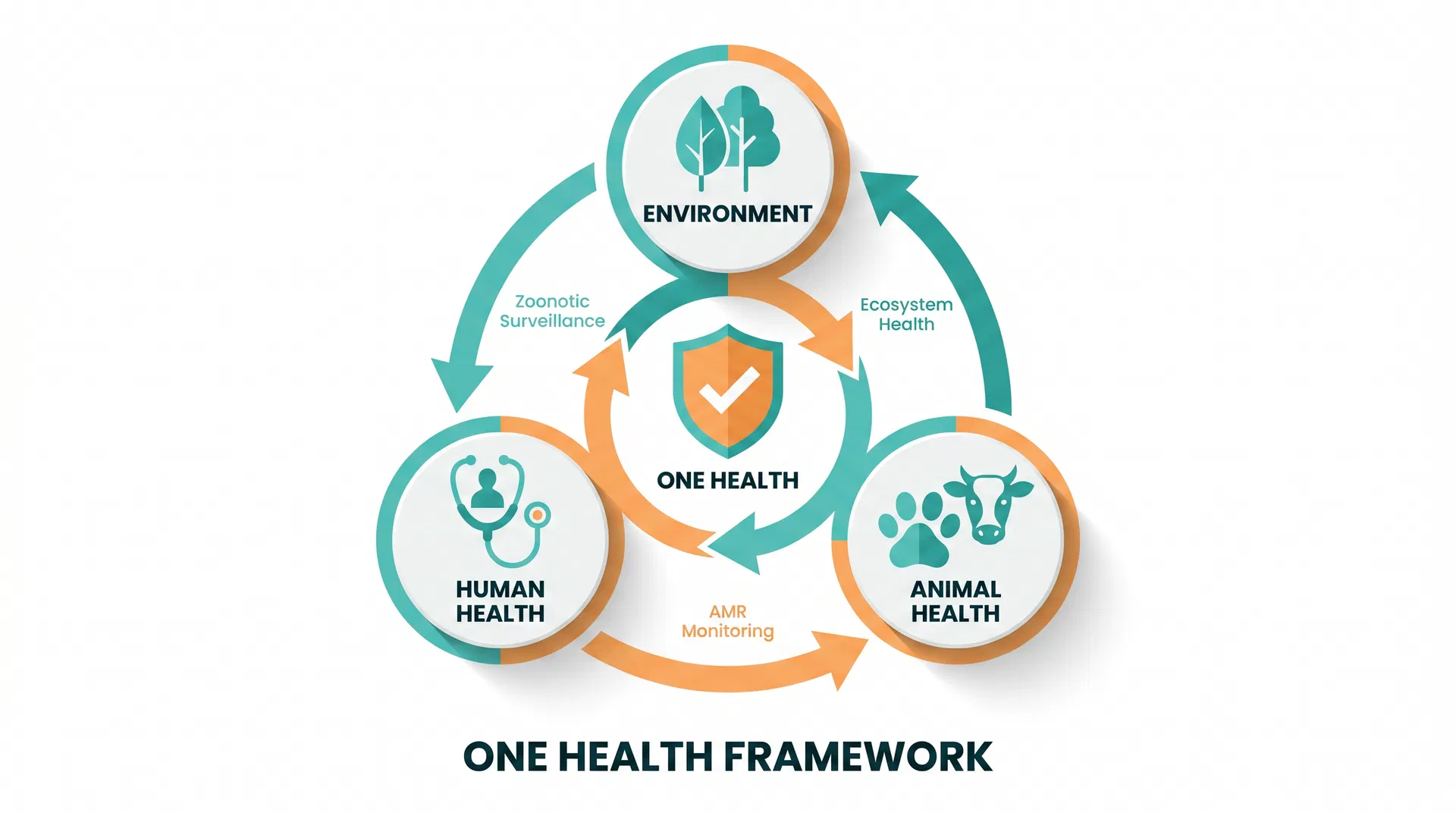
The COVID-19 pandemic served as a brutal reminder of a truth that epidemiologists and ecologists had long understood: the health of human populations cannot be meaningfully separated from the health of the animals with which they share the planet, nor from the integrity of the ecosystems in which all life is embedded. The One Health framework — a collaborative, multisectoral, and transdisciplinary approach that recognises the interconnection of human, animal, and environmental health — has moved from the margins of public health discourse to its centre. For biosecurity professionals, the One Health paradigm is not merely a philosophical orientation but an operational framework with concrete implications for surveillance architecture, response capacity, and governance design.
Origins and Conceptual Foundations
The intellectual roots of One Health extend to the 19th century physician Rudolf Virchow, who coined the term "zoonosis" and argued that medicine could not be divided into human and veterinary branches. The modern One Health framework was formalised in the early 2000s through the Manhattan Principles (2004) and subsequently elaborated by the Food and Agriculture Organization (FAO), the World Organisation for Animal Health (WOAH, formerly OIE), and the World Health Organization (WHO) through their tripartite collaboration, later expanded to a quadripartite with the United Nations Environment Programme (UNEP).
The framework rests on three foundational premises. First, that approximately 60–75% of emerging infectious diseases in humans are zoonotic — originating in animal reservoirs and crossing the species barrier through ecological disruption, agricultural intensification, wildlife trade, or climate-driven range shifts. Second, that antimicrobial resistance (AMR) is a shared challenge across human medicine, veterinary medicine, and agriculture that cannot be addressed by any single sector in isolation. Third, that ecosystem degradation — deforestation, wetland loss, soil degradation — directly undermines the ecological buffers that historically limited pathogen spillover events.
Zoonotic Disease Surveillance: The Biosecurity Imperative
Effective biosecurity in the One Health era requires surveillance systems that operate simultaneously at the human-animal-environment interface. Traditional disease surveillance architectures — siloed within human health ministries, veterinary departments, and environmental agencies — are structurally ill-equipped to detect the early signals of zoonotic emergence. The 2003 SARS outbreak, the 2009 H1N1 influenza pandemic, the Ebola outbreaks in West and Central Africa, and the COVID-19 pandemic all demonstrated the catastrophic consequences of surveillance gaps at the human-animal interface.
Integrated surveillance platforms — such as the Global Early Warning System for Major Animal Diseases (GLEWS+), the PREDICT programme, and national integrated disease surveillance and response (IDSR) systems — represent operational expressions of the One Health surveillance philosophy. These platforms aggregate data from human clinical networks, veterinary diagnostic laboratories, wildlife monitoring programmes, and environmental sampling to generate holistic risk assessments. In sub-Saharan Africa, where the burden of zoonotic disease is disproportionately high and surveillance infrastructure is chronically underfunded, strengthening One Health surveillance capacity is both a biosecurity and a development imperative.
AMR as a One Health Challenge
Antimicrobial resistance exemplifies the One Health challenge with particular clarity. The selective pressure driving AMR is distributed across three domains: therapeutic use of antibiotics in human medicine, prophylactic and growth-promoting use in livestock production, and environmental contamination of soil and water bodies with antibiotic residues and resistant organisms. Resistance genes do not respect the boundaries between these domains — they move freely through horizontal gene transfer, environmental persistence, and the food chain.
The WHO Global Action Plan on AMR (2015) and the subsequent national action plans developed by member states explicitly adopt a One Health framework, calling for coordinated surveillance of resistance in human pathogens, veterinary pathogens, and environmental reservoirs. In practice, however, implementation has been uneven. Many low- and middle-income countries lack the laboratory infrastructure to conduct integrated AMR surveillance, and the political will to regulate antibiotic use in agriculture — a powerful economic sector — has been inconsistent even in high-income settings.
Climate Change, Ecosystem Disruption, and Biosecurity Risk
The One Health framework is increasingly being extended to encompass the biosecurity implications of climate change and ecosystem disruption. Rising temperatures are expanding the geographic range of vector-borne diseases — malaria, dengue, Rift Valley fever, and tick-borne encephalitis are all shifting poleward and to higher altitudes. Altered precipitation patterns are affecting the breeding habitats of disease vectors and the survival of environmental pathogens. Permafrost thaw in Arctic and sub-Arctic regions is releasing ancient microbial communities — including potentially viable pathogens — that have been frozen for millennia.
Deforestation and land-use change are among the most potent drivers of zoonotic spillover. Forest fragmentation brings human populations into contact with wildlife reservoirs of novel pathogens, disrupts the ecological communities that regulate reservoir host populations, and creates edge habitats where spillover risk is elevated. The Nipah virus outbreaks in Malaysia and Bangladesh, the Hendra virus outbreaks in Australia, and the emergence of Ebola in Central Africa have all been linked to deforestation and the resulting disruption of bat ecology — a pattern that is likely to intensify as land-use pressures increase across tropical biodiversity hotspots.
One Health Governance: Institutional Architecture and Gaps
Translating the One Health concept into effective governance requires institutional architecture that is currently incomplete at both national and international levels. At the national level, One Health requires mechanisms for routine information sharing, joint risk assessment, and coordinated response across health ministries, agriculture ministries, environmental agencies, and wildlife authorities. In practice, these agencies often operate with separate mandates, budgets, and information systems, creating structural barriers to the integrated approach that One Health demands.
At the international level, the tripartite/quadripartite collaboration between WHO, FAO, WOAH, and UNEP provides a normative framework but lacks binding authority and dedicated funding. The International Health Regulations (IHR 2005) — the primary international legal instrument for global health security — focus predominantly on human health events and have limited provisions for zoonotic surveillance and response. The Pandemic Treaty currently under negotiation at WHO represents an opportunity to embed One Health principles more firmly in international law, though the political negotiations have been contentious.
Conclusion
The One Health framework is not a slogan — it is a scientifically grounded, operationally necessary approach to biosecurity in an era of ecological disruption, globalised trade, and climate change. For Africa, where the burden of zoonotic disease is high, surveillance infrastructure is fragile, and the human-wildlife interface is extensive, One Health is not merely a global health priority but a continental survival strategy. Building the institutional capacity, political will, and scientific expertise to implement One Health at scale — from village-level community health workers to national biosafety authorities to international governance bodies — is among the most important investments that governments, donors, and the scientific community can make in the biosecurity of the 21st century.
Policy and Regulatory Framework: Strengthening the One Health Governance Architecture
The One Health framework — integrating human, animal, and environmental health — has achieved broad rhetorical endorsement at the international level. The challenge is translating that endorsement into binding, enforceable governance instruments. The table below maps the critical gaps between the One Health ideal and the current international regulatory architecture.
| Governance Gap | Instrument Affected | One Health Driver |
|---|---|---|
| No binding international One Health treaty | WHO, FAO, WOAH tripartite framework | Zoonotic spillover events require coordinated multi-sector response |
| Human-animal interface surveillance not standardised | IHR (2005), WOAH Terrestrial Animal Health Code | Inconsistent reporting thresholds across species and sectors |
| Environmental health data excluded from IHR notification obligations | IHR (2005) Article 6 | Antimicrobial resistance in soil and water precedes human outbreaks |
| Wildlife trade regulation fragmented across CITES, CBD, and national law | CITES, CBD, Nagoya Protocol | Live animal markets and bushmeat trade as spillover amplifiers |
| One Health capacity building underfunded in African LMICs | CBD Article 22, Sendai Framework Priority 1 | Veterinary and environmental surveillance infrastructure gaps |
| Climate-health nexus not integrated into One Health frameworks | UNFCCC, Paris Agreement Article 7 | Vector range expansion driven by temperature and rainfall shifts |
A Five-Point Reform Agenda for the One Health International Architecture
1. Negotiate a Binding One Health Framework Convention under the WHO-FAO-WOAH Tripartite. The Pandemic Accord negotiations (INB process, 2024-2025) provide a political window to embed One Health obligations into a legally binding instrument. The framework convention should require States Parties to establish National One Health Coordination Mechanisms with statutory authority over human, animal, and environmental health surveillance, and to report integrated zoonotic risk assessments to the WHO Event Information Site on a quarterly basis.
2. Extend IHR (2005) Notification Obligations to Cover Veterinary and Environmental Sentinel Events. The IHR Review Committee should recommend amendments to Annex 2 of the IHR to include: (a) unusual mortality events in wildlife populations within 50 km of human settlements; (b) detection of novel antimicrobial resistance genes in environmental samples at concentrations above WHO threshold levels; and (c) confirmed spillover events at the human-livestock interface regardless of whether human cases have been confirmed.
3. Establish a One Health Early Warning System for Africa under the Africa CDC Framework. The Africa CDC's Integrated Disease Surveillance and Response (IDSR) framework should be expanded to include a dedicated One Health early warning module, integrating real-time data from veterinary laboratories, environmental monitoring stations, and community health workers into a unified risk dashboard accessible to national biosafety and public health authorities.
4. Reform CITES to Address Live Animal Trade as a Zoonotic Spillover Risk. The CITES Standing Committee should mandate a systematic review of all Appendix II and III listings for species identified as high-risk spillover hosts by the PREDICT programme and WOAH's disease prioritisation framework. The review should result in enhanced trade controls, mandatory veterinary certification, and real-time electronic permitting for high-risk species movements.
5. Integrate One Health Metrics into the Sendai Framework for Disaster Risk Reduction Monitoring. The Sendai Framework's seven global targets should be supplemented with One Health-specific indicators, including: zoonotic disease incidence at the human-animal interface; antimicrobial resistance prevalence in food-producing animals; and ecosystem integrity indices for high-biodiversity spillover risk zones. These metrics should feed into the Sendai Framework Monitor and inform national disaster risk reduction strategies.
"One Health is not a slogan — it is a governance imperative. The next pandemic will not wait for our institutional architecture to catch up." — Dr. Joseph Odongo Oduor, One Health and Biosecurity Specialist