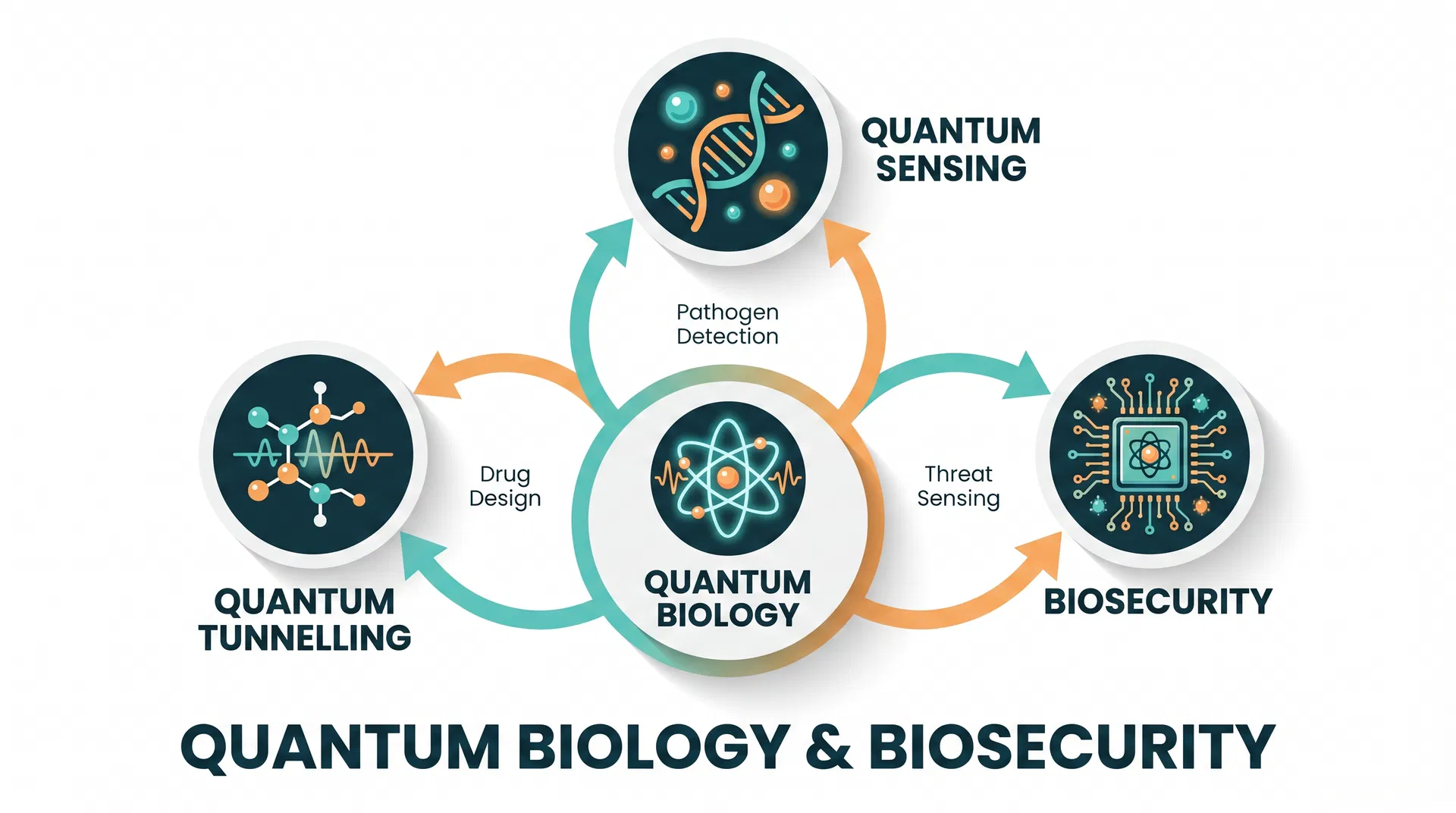
Quantum biology occupies a remarkable intellectual territory where the counterintuitive laws of quantum mechanics intersect with the messy, warm, and wet world of living systems. For decades, the prevailing assumption in biology was that quantum effects — superposition, entanglement, and tunnelling — were too fragile to survive in biological environments. That assumption is now being systematically dismantled. From the near-perfect efficiency of photosynthesis to the navigational precision of migratory birds, quantum coherence appears to play a functional role in biology in ways that challenge classical models and open entirely new avenues for biosecurity research and biotechnological innovation.
The implications for biosecurity are both profound and underappreciated. Biosecurity, broadly defined, encompasses the protection of human, animal, and plant health from biological threats — whether natural pathogens, engineered organisms, or environmental toxins. As quantum biology matures as a discipline, it is beginning to inform the design of next-generation biosensors, antimicrobial agents, and diagnostic platforms with sensitivity and specificity that classical approaches cannot match.
Quantum Coherence in Biological Systems
The discovery that the Fenna–Matthews–Olson (FMO) complex in green sulphur bacteria exhibits quantum coherence during energy transfer was a landmark moment in quantum biology. Subsequent research extended these findings to higher plants and algae, suggesting that quantum effects may be a conserved feature of photosynthetic machinery rather than an evolutionary curiosity. The FMO complex achieves near-unity energy transfer efficiency by exploiting quantum superposition — allowing excitation energy to sample multiple pathways simultaneously and find the most efficient route to the reaction centre.
From a biosecurity standpoint, understanding quantum coherence in photosynthetic organisms has direct relevance to the detection of phytotoxins and herbicidal agents that disrupt photosynthetic electron transport. Quantum-enhanced biosensors calibrated to detect perturbations in chlorophyll fluorescence at the quantum level could provide early warning systems for agricultural biosecurity threats with sensitivity several orders of magnitude beyond current enzyme-linked immunosorbent assay (ELISA) platforms.
Quantum Tunnelling and Enzyme Catalysis
Proton and electron tunnelling — the quantum mechanical phenomenon whereby particles traverse energy barriers that would be classically insurmountable — has been demonstrated in a range of enzymatic reactions. Alcohol dehydrogenase, aromatic amine dehydrogenase, and several other enzymes exploit tunnelling to achieve catalytic rates that cannot be explained by classical transition state theory alone. The temperature dependence of tunnelling in these systems has been characterised through kinetic isotope effect (KIE) studies, providing a mechanistic window into quantum contributions to enzyme function.
For biosecurity and pharmaceutical science, quantum tunnelling in enzymes has direct implications for antimicrobial drug design. Many antibiotic targets — including dihydrofolate reductase (DHFR) and beta-lactamase — are enzymes whose catalytic mechanisms involve proton transfer steps susceptible to tunnelling. Designing inhibitors that specifically disrupt tunnelling-dependent catalysis, rather than merely competing for the active site, represents a fundamentally new strategy for combating antimicrobial resistance (AMR). As AMR continues to emerge as one of the defining biosecurity threats of the 21st century, quantum-informed drug design offers a promising complementary approach to conventional medicinal chemistry.
Quantum Sensing and Next-Generation Biosensors
Perhaps the most immediately translatable application of quantum biology to biosecurity lies in quantum sensing. Nitrogen-vacancy (NV) centres in diamond — point defects that behave as quantum two-level systems — can detect magnetic fields at the nanoscale with extraordinary sensitivity. NV-based magnetometers have been used to image the magnetic fields generated by action potentials in individual neurons and to detect the magnetic signatures of single bacterial cells. The same technology is being adapted for the detection of biological toxins, viral particles, and chemical warfare agents at concentrations far below the detection thresholds of conventional analytical chemistry.
Quantum dot (QD) biosensors represent another frontier. QDs are semiconductor nanocrystals whose optical properties are governed by quantum confinement effects — the size-dependent quantisation of electronic energy levels. By conjugating QDs to antibodies, aptamers, or molecularly imprinted polymers, researchers have developed biosensors capable of detecting pathogens including Salmonella, E. coli O157:H7, and Bacillus anthracis spores at single-cell sensitivity. The tuneable emission spectra of QDs enable multiplexed detection — simultaneously identifying multiple threat agents in a single assay — a capability of considerable strategic value in biodefence and food safety surveillance.
Avian Magnetoreception and Cryptochrome Biology
The radical pair mechanism — a quantum mechanical process involving the spin dynamics of transient radical pairs — is the leading hypothesis for avian magnetoreception, the ability of migratory birds to navigate using Earth's magnetic field. The cryptochrome proteins in the avian retina are believed to generate radical pairs upon photoexcitation, with the spin state of the pair modulated by the geomagnetic field, ultimately influencing downstream signalling cascades that encode directional information.
Beyond navigation biology, cryptochrome research has revealed that these proteins are deeply integrated into circadian clock machinery across taxa — from insects to mammals, including humans. Disruption of cryptochrome function by anthropogenic electromagnetic fields, novel chemical agents, or engineered pathogens targeting circadian regulation represents an emerging biosecurity concern. Understanding the quantum mechanical basis of cryptochrome function is therefore not merely an academic exercise but a prerequisite for assessing the biosecurity implications of technologies that interact with biological quantum systems.
Implications for Biosafety Governance
The emergence of quantum biology as a mature scientific discipline creates new governance challenges. Technologies derived from quantum biological principles — including quantum-enhanced biosensors, quantum-informed antimicrobials, and quantum dot diagnostic platforms — will require regulatory frameworks that are currently absent or inadequate. The dual-use potential of quantum sensing technologies is particularly salient: the same NV-centre magnetometer that detects a pathogen in a clinical sample could, in principle, be used to map the electromagnetic signatures of secure facilities or biological containment systems.
Biosafety governance bodies, including national biosafety authorities and international organisations such as the Biological Weapons Convention (BWC) Implementation Support Unit, will need to develop technical literacy in quantum biology to anticipate and regulate these emerging risks. Integrating quantum biology into biosecurity education curricula, threat assessment frameworks, and international scientific exchange programmes is an urgent priority that the biosecurity community has yet to fully embrace.
Conclusion
Quantum biology is no longer a speculative frontier — it is an empirically grounded discipline with direct and growing relevance to biosecurity. From quantum-enhanced biosensors capable of detecting single pathogen particles to quantum-informed drug design strategies targeting AMR, the practical applications of quantum biological principles are beginning to materialise. For biosecurity professionals, molecular biologists, and policy makers alike, developing fluency in the language of quantum biology is becoming not merely advantageous but essential. The organisms that threaten human health have always exploited the full repertoire of physical law — it is time that those who defend against them did the same.
Policy and Regulatory Framework: Governing Quantum-Enabled Biosecurity Risks
The emergence of quantum biology as an applied science — particularly its intersection with pathogen design, biosensor development, and molecular surveillance — creates governance gaps that existing biosafety and biosecurity frameworks were not designed to address. The following table maps the most critical regulatory deficits against the international instruments that must evolve to close them.
| Governance Gap | Instrument Affected | Quantum/Biological Driver |
|---|---|---|
| No framework for quantum-enhanced pathogen modelling | Biological Weapons Convention (BWC) | Quantum simulation of protein folding and binding affinity |
| Biosensor data from quantum devices not covered by data-sharing obligations | WHO IHR (2005), Article 6 | Quantum dot biosensors detecting sub-threshold pathogen loads |
| Dual-use quantum biology research lacks mandatory risk assessment | Cartagena Protocol Annex III | Quantum coherence studies in engineered organisms |
| No international registry for quantum-biology research with biosecurity implications | Nagoya Protocol / BCH | Quantum-assisted directed evolution platforms |
| Capacity asymmetry: African states lack quantum biosensing infrastructure | CBD Article 22 / Sendai Framework | Quantum-enabled early warning systems concentrated in OECD states |
| Quantum cryptography for biosecurity data not standardised | WHO GOARN / GHSA | Interception risks for sensitive pathogen surveillance data |
A Six-Point Policy Reform Agenda for Quantum Biosecurity Governance
1. Amend the BWC Verification Protocol to Address Quantum-Enhanced Dual-Use Research. The Ninth BWC Review Conference (2026) should mandate the establishment of a scientific advisory panel to assess the dual-use implications of quantum biology, specifically addressing quantum-assisted protein design, quantum simulation of toxin-receptor interactions, and quantum-enhanced directed evolution. The panel's terms of reference should draw on the Fink Report's dual-use research of concern (DURC) framework and extend it to quantum-enabled methodologies.
2. Integrate Quantum Biosensor Data into the WHO International Health Regulations Framework. The IHR (2005) review process should include provisions requiring States Parties to report anomalous biosensor data from quantum-enabled surveillance platforms to the WHO Event Information Site within 24 hours of detection. Quantum dot biosensors capable of detecting pathogen loads below conventional PCR thresholds represent a qualitative advance in early warning capacity that the current IHR notification thresholds do not capture.
3. Establish a Quantum Biosecurity Capacity-Building Fund for African Union Member States. The African Union's Agenda 2063 health security pillar should include a dedicated quantum biosecurity capacity component, capitalised at a minimum of USD 30 million over five years, to deploy quantum-enabled biosensing networks at major ports of entry, livestock disease surveillance nodes, and public health laboratories across the continent.
4. Extend Cartagena Protocol Annex III Risk Assessment Guidance to Quantum-Assisted Organism Design. The AHTEG on synthetic biology should be mandated to develop supplementary guidance addressing organisms designed or optimised using quantum simulation platforms, including assessment criteria for emergent properties predicted by quantum models but not empirically validated in classical biological systems.
5. Mandate Dual-Use Review for Quantum Biology Publications in High-Impact Journals. Following the precedent established by the National Science Advisory Board for Biosecurity (NSABB) for gain-of-function research, journal editors and national biosafety authorities should establish a mandatory pre-publication dual-use review process for quantum biology studies with direct biosecurity implications, including quantum-assisted pathogen enhancement and quantum-enabled biosensor circumvention research.
6. Develop an International Quantum Biosecurity Standard under ISO/TC 212. The International Organization for Standardization's Technical Committee on Clinical Laboratory Testing and In Vitro Diagnostic Test Systems (ISO/TC 212) should develop a dedicated standard for quantum biosensing devices used in public health surveillance, covering sensitivity thresholds, data integrity requirements, and cross-border interoperability specifications.
"Quantum biology is not a distant frontier — it is an active research programme whose biosecurity implications are arriving faster than the governance frameworks designed to manage them." — Dr. Joseph Odongo Oduor, Biosafety and Biosecurity Specialist