A Turning Point in Biosecurity Legislation
In early 2026, the United States Congress introduced a landmark bipartisan bill that would mandate DNA synthesis screening at every point of synthesis across the country. The legislation, backed by members of both parties, represents the most significant federal action on biosecurity since the Select Agent Regulations of the early 2000s. Its core premise is straightforward: before any DNA sequence is synthesised into physical material, it must be screened against a hazard database to ensure it does not encode a select agent, toxin, or potential pandemic pathogen.
The urgency behind the bill is not theoretical. In February 2026, OpenAI's GPT-5 model, integrated with Ginkgo Bioworks' robotic cloud laboratory, autonomously designed and ran over 36,000 biological experiments without direct human involvement. While the experiments were conducted responsibly, the demonstration made clear that the barrier between computational sequence design and physical synthesis has collapsed. A motivated actor with access to a large language model and a commercial DNA synthesis order could, in principle, attempt to produce dangerous sequences — and current oversight frameworks were not designed for this reality.
How DNA Synthesis Screening Works
The BioScreens platform at bioscreens.org has been operating at the frontier of this challenge since its launch. Its DNA Sequence Screening tool accepts any FASTA sequence or raw nucleotide string and returns an instant synthesis permission decision — Granted or Denied — in under two seconds. The platform has now screened over 10 million sequences across 180+ countries.
What makes BioScreens technically distinctive is its use of cryptographic privacy protocols. When a researcher submits a sequence, the sequence itself is never transmitted in plaintext to the hazard database. Instead, a cryptographic representation is used to query the SafeDNA hazard database, ensuring that proprietary research sequences remain confidential even during the screening process. This addresses one of the primary objections that commercial synthesis providers have historically raised against mandatory screening: the fear that submitting sequences to a central authority would expose intellectual property.
| Screening Feature | BioScreens Capability |
|---|---|
| Decision speed | Under 2 seconds |
| Sequences screened | 10 million+ |
| Countries supported | 180+ |
| Privacy protection | Cryptographic protocols |
| Output formats | PDF report, JSON export, secure share link |
| Audit trail | Full history with status tracking |
The platform also provides nucleotide-level hit region maps — visual overlays that show exactly which base pairs triggered a hazard match, which organism the match corresponds to, and the accession number of the reference sequence. This level of granularity is essential for researchers who receive a Denied result and need to understand whether the match is a false positive or a genuine concern.
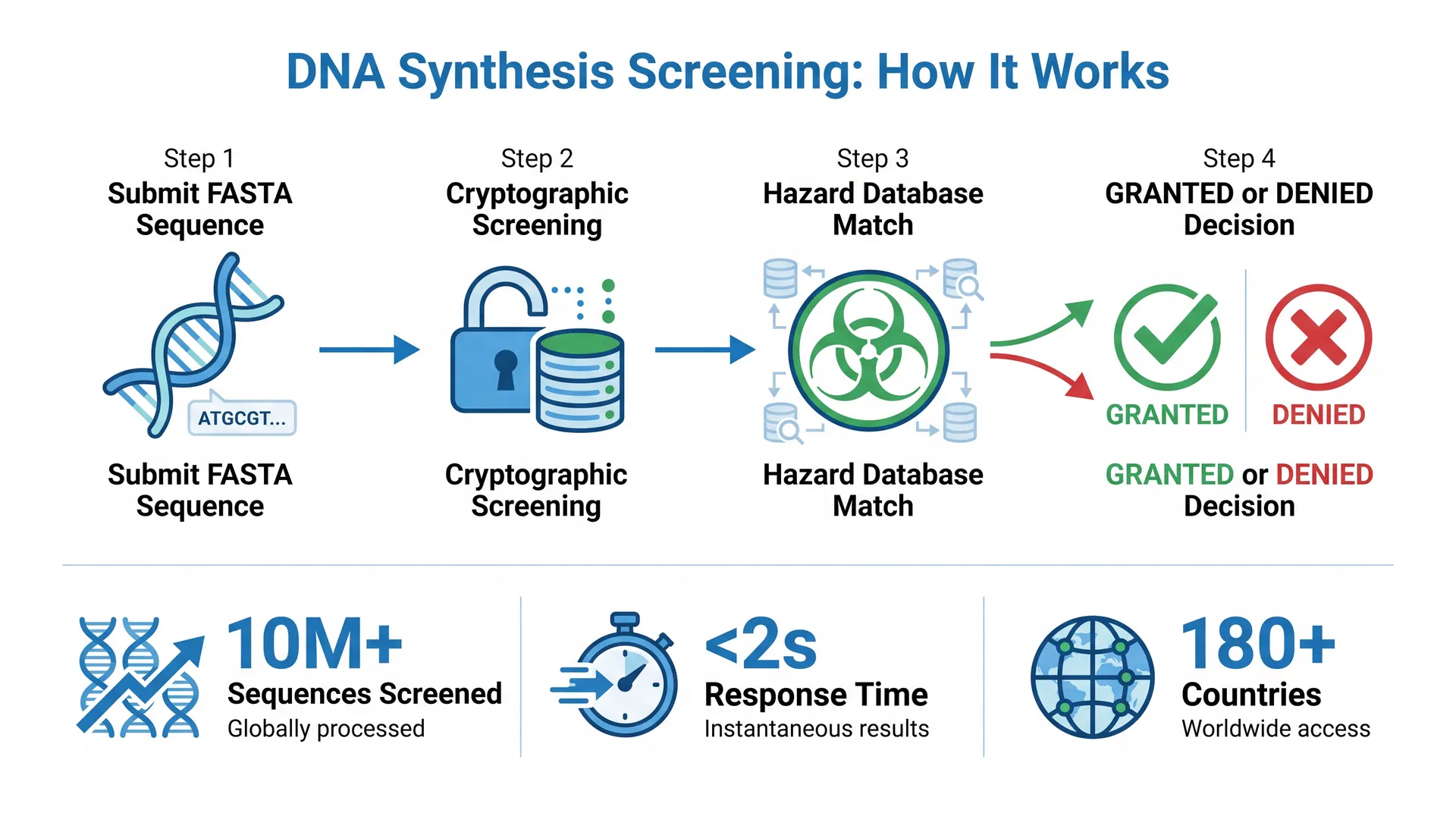
Infographic: The four-step BioScreens DNA synthesis screening process, from FASTA submission to synthesis decision.
The Gap the New Bill Must Close
Despite BioScreens' capabilities, the 2026 bill faces a significant technical challenge that its sponsors acknowledge: AI-designed sequences that are engineered to evade current detection methods. Conventional hazard databases are built around known sequences — sequences that have been characterised, named, and catalogued. An AI model that generates a novel sequence with equivalent biological function but low sequence similarity to any known pathogen could, in principle, pass a standard screening check.
A University of Virginia data scientist writing in The Conversation in April 2026 noted that the bipartisan bill "does not yet address AI-designed sequences that evade current detection methods." This is not a criticism of the bill's intent but a recognition that biosecurity policy is in a race with biotechnology capability. The solution likely involves function-based screening — evaluating what a sequence does rather than only what it resembles — a capability that platforms like BioScreens are actively developing.
What This Means for Researchers and Institutions
For researchers in the United States, the bill's passage would make DNA synthesis screening a legal requirement rather than a best practice. Institutions that already use BioScreens or equivalent platforms would be well positioned for compliance. Those that do not would need to integrate screening into their synthesis workflows before submitting orders to commercial providers.
For international researchers, the implications are equally significant. Because the bill applies to US-based synthesis providers — who supply a substantial fraction of the world's custom DNA — international orders would also be subject to screening. A researcher in Nairobi, Kuala Lumpur, or Berlin ordering a sequence from a US provider would have that sequence screened under the new framework, regardless of their home country's biosecurity regulations.
The global dimension is already visible in BioScreens' user base, which spans 180+ countries. The platform's multi-language OCR support — covering English, French, German, and Arabic — reflects the reality that biosecurity compliance is not a US-only concern. Malaysia's April 2026 WHO-sponsored Responsible Use of Life Sciences workshop, which focused on strengthening dual-use research governance across the Western Pacific region, is one of many indicators that biosecurity screening is becoming a global standard.
The Road Ahead
The 2026 bipartisan DNA screening bill represents a watershed moment for biosecurity governance. Whether it passes in its current form or is amended, it signals that the era of unscreened DNA synthesis is ending. Platforms like BioScreens, which have been building the technical infrastructure for this transition for years, are positioned to become essential compliance tools for the global research community.
For researchers who want to get ahead of the regulatory curve, BioScreens offers free access to its DNA Sequence Screening tool at bioscreens.org. Submitting a sequence takes seconds; the cryptographic privacy guarantee means there is no risk to proprietary research; and the PDF report provides a compliance record that institutional biosafety committees and ethics boards can review.
The question is no longer whether DNA synthesis screening will become mandatory. The question is how quickly the technical standards will catch up with the biological capabilities that are making the mandate necessary.