From Pathogen Detection to Population Health Intelligence
The COVID-19 pandemic established wastewater surveillance as a credible and powerful tool for infectious disease monitoring. But the scientific community has long recognised that the information encoded in municipal wastewater extends far beyond the presence or absence of a single respiratory virus. Wastewater is, in effect, a comprehensive chemical and biological record of everything that passes through the bodies of the people in a catchment area — and the analytical tools now available to decode that record are more powerful than ever before.
Wastewater-based epidemiology (WBE) is expanding rapidly beyond its pandemic-era focus to encompass a much broader portfolio of public health applications: antimicrobial resistance (AMR) surveillance, pharmaceutical and illicit drug monitoring, nutritional and metabolic health assessment, and the detection of chemical and biological threats. Each of these applications leverages the same fundamental insight — that pooled community wastewater is a uniquely comprehensive and unbiased population-level biospecimen — but applies it to different dimensions of public health intelligence.
Antimicrobial Resistance: The Silent Pandemic in the Sewers
Antimicrobial resistance is one of the most serious and underappreciated threats to global health security. The World Health Organisation estimates that AMR directly caused 1.27 million deaths in 2019 and contributed to 4.95 million deaths — figures that are projected to rise dramatically in the coming decades if current trends continue. Yet AMR surveillance remains fragmented, inconsistent, and heavily dependent on clinical isolates from healthcare settings — a sample that captures only a fraction of the true burden of resistance in the community.
Wastewater surveillance offers a transformative complement to clinical AMR surveillance. By analysing wastewater for resistance genes (ARGs), mobile genetic elements (MGEs), and resistant bacterial isolates, WBE can provide a population-level picture of the AMR landscape that no clinical surveillance system can replicate. Wastewater captures resistance determinants from all members of the community — not just those who are ill enough to seek healthcare — and from environmental reservoirs including livestock, wildlife, and soil bacteria that contribute to the resistance gene pool.
Research published in leading journals has demonstrated that wastewater surveillance can detect a wide range of clinically important resistance mechanisms, including carbapenem resistance genes (blaKPC, blaNDM, blaOXA-48), extended-spectrum beta-lactamase (ESBL) genes, and methicillin resistance (mecA). The temporal dynamics of these signals in wastewater correlate with antibiotic prescribing patterns and clinical AMR trends, suggesting that WBE could serve as a leading indicator of emerging resistance threats.
| AMR Application | What WBE Detects | Public Health Value |
|---|---|---|
| Resistance gene surveillance | ARGs (blaKPC, blaNDM, mecA, vanA) | Community-level resistance burden independent of clinical sampling |
| Mobile genetic element tracking | Plasmids, integrons, transposons | Horizontal gene transfer dynamics and resistance spread |
| Resistant organism monitoring | ESBL-producing Enterobacteriaceae, MRSA, VRE | Environmental reservoir characterisation |
| Antibiotic usage correlation | Antibiotic metabolites + resistance genes | Prescribing behaviour impact assessment |
Pharmaceutical and Drug Monitoring: The Pharmacoepidemiological Dividend
Wastewater surveillance has a well-established track record in the monitoring of pharmaceutical and illicit drug use at the population level. The field of wastewater-based drug epidemiology has demonstrated that the concentrations of drug metabolites in wastewater correlate reliably with community-level consumption patterns — providing a real-time, objective, and non-stigmatising measure of drug use that complements self-report surveys and clinical data.
Applications include the monitoring of illicit drug use (cocaine, methamphetamine, heroin, cannabis, novel psychoactive substances), prescription drug consumption (opioids, benzodiazepines, antidepressants), and over-the-counter medication use. During the COVID-19 pandemic, wastewater drug surveillance documented significant changes in substance use patterns — including increases in alcohol and cannabis consumption and decreases in cocaine use — that preceded and corroborated survey-based evidence.
From a biosecurity perspective, pharmaceutical surveillance in wastewater has important applications in monitoring for the misuse of controlled substances with potential for weaponisation, and in detecting the community-level presence of chemical agents that might indicate a deliberate release event.
The One Health Dimension: Integrating Human, Animal, and Environmental Surveillance
Wastewater surveillance is inherently a One Health tool. The wastewater flowing to a treatment plant in a mixed urban-rural catchment may contain biological material from humans, domestic animals, livestock, and wildlife — as well as from the soil, water, and air of the surrounding environment. This makes wastewater a uniquely comprehensive sample for One Health surveillance, capable of detecting zoonotic pathogens at the human-animal interface before they cause human cases.
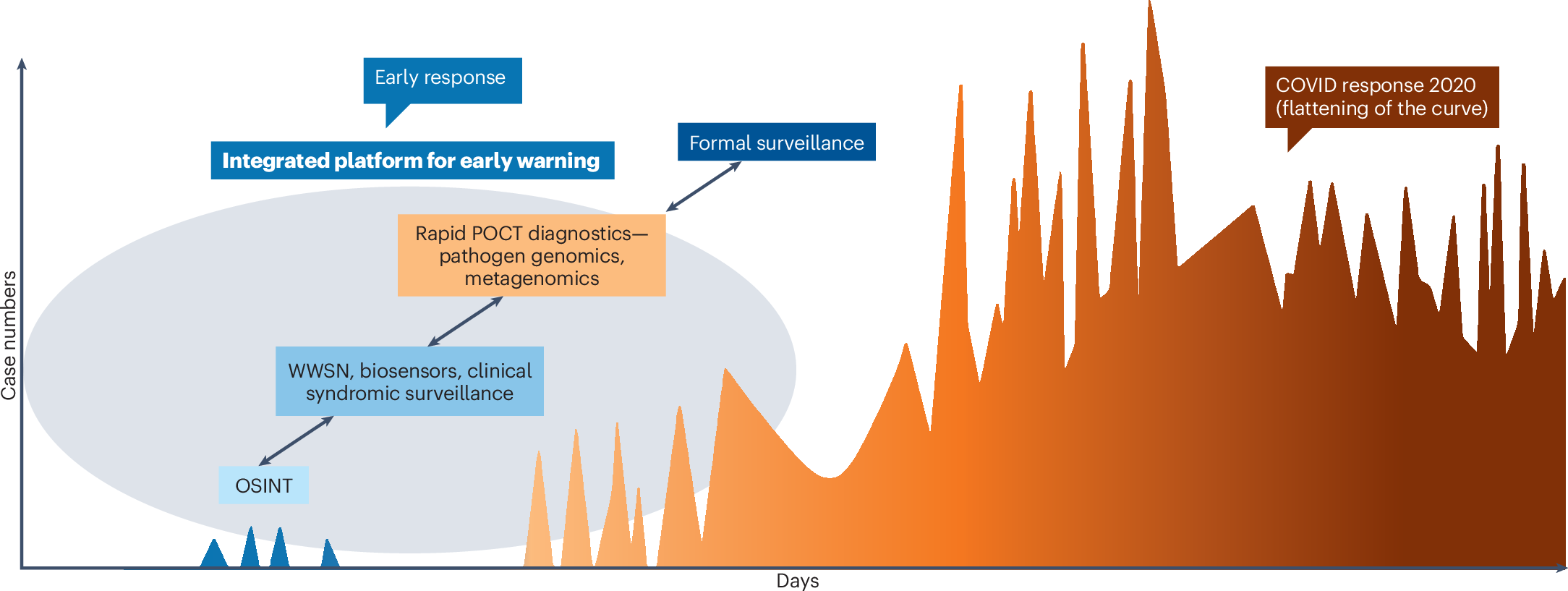
The integration of wastewater surveillance with genomic sequencing — particularly metagenomic approaches that can simultaneously characterise all microbial and viral genetic material in a sample — creates a surveillance system of extraordinary breadth. A single metagenomic analysis of a wastewater sample can simultaneously screen for hundreds of known pathogens, detect novel variants of known pathogens, identify emerging resistance genes, and characterise the microbial ecology of the catchment area.
This capability is particularly relevant for pandemic preparedness. The majority of pandemic pathogens are zoonotic in origin — they emerge from animal reservoirs and spill over into human populations. A wastewater surveillance system that monitors the One Health interface — including samples from slaughterhouses, wet markets, and agricultural runoff — could provide the earliest possible warning of a spillover event, enabling a pre-emptive response before human-to-human transmission is established.
Building the Infrastructure for Continuous Biosurveillance
The full potential of wastewater surveillance as a public health and biosecurity tool will only be realised through sustained investment in the infrastructure, analytical capacity, and institutional frameworks needed to support continuous, multi-pathogen, multi-analyte surveillance at national and global scale.
This infrastructure has three essential components. The first is physical sampling infrastructure: a network of automated samplers at wastewater treatment plants and key nodes in the sewer network, capable of collecting representative samples on a continuous or near-continuous basis. The second is analytical capacity: laboratory infrastructure capable of processing large numbers of samples rapidly, using a combination of targeted molecular assays and untargeted metagenomic sequencing. The third is data integration and interpretation capacity: computational systems capable of integrating wastewater signals with clinical, meteorological, demographic, and genomic data to generate actionable public health intelligence.
The COVID-19 pandemic demonstrated that this infrastructure can be built rapidly when the political will and funding are available. The challenge now is to sustain and expand it — to transform the ad hoc surveillance systems built during the pandemic into permanent, multi-purpose biosurveillance infrastructure that can serve as the foundation of a more resilient global health security architecture.
Wastewater surveillance is not a silver bullet. It works best as one component of an integrated surveillance system that combines environmental monitoring with clinical surveillance, genomic sequencing, and epidemiological investigation. But as an early warning system — as the sentinel that sounds the alarm before the clinical system is overwhelmed — it has no equal.
References
- Balcázar et al. (2025) — "Wastewater-Based Epidemiology as a Complementary Tool for Antimicrobial Resistance Surveillance." PMC. Available at: https://pmc.ncbi.nlm.nih.gov/articles/PMC12278801/
- NCBI (2024) — "Wastewater Surveillance for Emerging Pathogen Threats." Available at: https://www.ncbi.nlm.nih.gov/books/NBK610710/
- Nature (2022) — "Wastewater surveillance of pathogens can inform public health responses." Available at: https://www.nature.com/articles/s41591-022-01940-x
- CDC Advanced Molecular Detection — "Wastewater Surveillance: A New Frontier for Public Health." Available at: https://www.cdc.gov/advanced-molecular-detection/php/success-stories/wastewater-surveillance.html